
Testing period: 24 July – 26 August 2026
SignalSumo is a strong choice for SEO professionals and agencies that want traditional SEO tools combined with AI visibility tracking.
SignalSumo is a broad, modern SEO platform that combines traditional search optimisation with AI-search visibility in a single workflow — and after a month on the Agency plan across thirteen sites, it holds up.
We went in expecting the AI-search features to be the usual thin layer bolted onto a conventional suite. They aren’t. SignalSumo tracks individual buyer prompts against ChatGPT, Google AI Overviews, Gemini, Perplexity and Claude, returns the actual answer text with cited source URLs, and — the feature that most impressed us — diffs each scan against the last, showing which brands entered and left the AI answer since the previous week. That is a genuinely useful piece of engineering, and we haven’t seen it done as cleanly elsewhere at this price.
The traditional SEO side is substantial rather than decorative. We maxed the crawler at 100,000 pages on a single domain; it completed in roughly two hours with JavaScript rendering enabled and no supervision required. The backlink reporting goes deeper than we expected for a $249/month platform — Class-C subnet analysis, link placement breakdowns, five-year growth history, and page-level authority mapping that identifies which URLs are leaking equity to 404s.
What we found rough: a display bug in the backlink gap tool showing a dofollow ratio of 108,666%. Backlink monitoring needs several weeks of snapshots before the trend charts mean anything. The backlink audit grades a 1,000-link sample rather than the full profile. And in AI Competitor Research, both compared brands can come back scoring identically and both labelled “AI leader,” which blunts the comparison.
None of those are dealbreakers. They’re the rough edges of a platform that is clearly newer than Ahrefs or Semrush and equally clearly built by people who understand the problem.
Strongest fit: small businesses, freelance SEOs, consultants, small-to-mid agencies and in-house marketing teams — particularly anyone whose clients have started asking whether they show up in ChatGPT.
How We Tested SignalSumo
We ran SignalSumo on the Agency plan from 24 July 2026, across thirteen live domains spanning low to high traffic and mixed niches — including Mangools, SE Ranking, Leofame, MakeMyTrip, HypeAuditor, HubSpot, Zoho, Citedy and our own site, ShopperChecked.
We used every major tool in the platform: Website Audit, Rank Tracker, Keyword Research, Competitor Research, Backlink Intelligence, Backlink Monitor, Backlink Gap, AI Prompt Research, AI Prompt Tracker, AI Competitor Research, Local SEO and the Local SEO Grid, Content Optimizer, SEO Uptime Monitor, AI Growth Plan, Google Search Console integration, Executive Reports with white-label scheduling, and API key management.
We held accounts with Ahrefs, Semrush and SE Ranking throughout and used them as reference points for data plausibility.
What we did not do: we did not run controlled, like-for-like index-size benchmarks with matched query parameters across all three competing platforms — a proper backlink index comparison is a bigger methodological exercise than a review of this scope allows, and we’d rather say so than publish soft numbers. Our comments on data depth below are based on what SignalSumo returned on domains we know well, not on a formal head-to-head.
All screenshots in this review are from our own account.
SignalSumo at a Glance
| Attribute | Detail |
|---|---|
| Platform | SignalSumo — AI-Powered SEO Intelligence Platform |
| Operator | SignalSumo LLC, San Francisco, California, USA |
| Category | All-in-one SEO suite with integrated AI search visibility (GEO/AEO) |
| Tool count | ~20 tools across AI Search, Core SEO, Monitoring & Growth, and Agency groups |
| Feature gating | None — every paid plan includes every tool; plans differ by quota |
| AI engines tracked | ChatGPT, Google AI Overviews, Gemini, Perplexity, Claude |
| Search engines | Google, Bing, Yahoo and major localised variants |
| Rank tracking | By location (to postal-code level) and device, with SERP feature monitoring |
| Site crawler | Up to 100,000 pages, 50+ checks per page, JavaScript rendering |
| Crawl performance (observed) | 100,000 pages in ~2 hours with JS rendering on |
| Backlink analysis | DR, referring domains, anchors, toxicity, Class-C, velocity, disavow, CSV |
| Integrations | Google Search Console, REST API, MCP server |
| Agency features | White-label PDF/CSV/HTML reports, multi-client workspaces, audit embed widget |
| Free plan | Yes — permanent free tier |
| Free trial | 7 days of full Pro access, no credit card |
| Pricing (monthly) | Mid $49 · Pro $99 · Agency $249 |
| Pricing (annual) | $490 · $990 · $2,499 (≈$40.83 · $82.50 · $208.25 per month) |
| ShopperChecked rating | 4.3 / 5 — Highly Recommended |
What Is SignalSumo?
SignalSumo is a subscription SEO platform that combines conventional search optimisation tooling with generative-engine-optimisation tooling in a single product.
It addresses both of the questions that now matter to anyone responsible for search visibility:
- Where do my pages rank in Google? — through crawling, rank tracking, keyword research and backlink analysis.
- Does an AI assistant recommend my brand when a buyer asks it a question? — by running real prompts against AI engines and recording whether, where and how the brand appears.
Most established platforms were built entirely around the first question and are retrofitting the second. SignalSumo treats both as first-class parts of the platform — its navigation puts AI Search ahead of Core SEO, and after a month of use that ordering reflects where the product’s real investment has gone.
SignalSumo LLC is registered in California with a San Francisco address with offices in India and Singapore.
What Makes SignalSumo Different: Two Worlds That Are Merging
For twenty years, SEO measurement followed one chain:
rankings → clicks → traffic → conversions
That chain still works and still drives the overwhelming majority of organic traffic. But a second chain now runs alongside it:
AI mentions → recommendations → citations → AI Share of Voice → brand visibility
When a buyer asks an assistant “what’s the best project management tool for a five-person team,” they don’t get ten blue links. They get a synthesised answer naming three or four brands. There is no page two. A brand is on the shortlist or it is invisible.
The two chains are driven by overlapping but genuinely different signals. Rankings respond to on-page optimisation, technical health and backlinks. AI recommendations respond to entity clarity, structured data, extractable answer formatting, and above all third-party corroboration from the sources a model consults.
Most marketing teams now need two datasets, two measurement frameworks and two optimisation programmes — which in practice has meant two subscriptions and no way to see how the two interact.
SignalSumo’s proposition is that these belong in one workflow. In use, we found the integration genuinely works rather than being a marketing claim:
- Keyword research surfaces the questions people ask — which become the prompts tracked in AI engines. The AI Prompt Research tool has a Monitor button on every discovered prompt that drops it straight into the tracker.
- The rank tracker shows a keyword holding position while GSC Insights shows clicks falling — and the AI visibility data explains why, because an AI Overview is absorbing the click.
- Backlink gap analysis produces domains linking to competitors — and AI competitor research produces the sources AI engines cite about those competitors. The overlap is a high-value outreach target set.
- The technical audit finds broken pages and scores schema, entity clarity and extractability in the same crawl.
That last point is the one we’d highlight to anyone evaluating the platform. Running a technical audit that returns an SEO Health score and a GEO score side by side, from the same crawl of the same pages, is the correct design — and several much larger competitors still haven’t done it.
Who Is SignalSumo For?
| User type | Fit | Why |
|---|---|---|
| Small business owner | Excellent | $49/mo covers audit, 100 tracked keywords, backlinks, competitors, local SEO and AI prompt tracking |
| Freelance SEO | Excellent | $99/mo gives 10 client projects, 750 keywords, white-label PDFs and executive reports |
| SEO consultant | Excellent | AI Share of Voice is a deliverable most competitors cannot yet produce |
| Small-to-mid agency | Excellent | $249/mo gives 25 projects, 2,000 keywords, 5 seats, white-label embed widgets |
| In-house SEO team | Strong | Broad capability, GSC integration and integrated GEO auditing suit in-house work |
| Marketing generalist | Excellent | Severity-ranked audits and the AI Growth Plan handle triage a non-specialist cannot |
| GEO/AEO specialist | Strong | Prompt-level architecture and citation-source capture are the right primitives |
| Local business | Strong | Postal-code-level tracking plus the Local SEO Grid and AI visibility for “near me” prompts |
| Large enterprise | Moderate | Seat counts and API throughput become limiting at very large scale |
PART ONE: THE AI SEARCH TOOLS
This is where SignalSumo earns its rating, and where we spent most of our testing time.
Understanding AI Visibility
- AI visibility — how often and how favourably a brand appears inside AI-generated answers.
- GEO (Generative Engine Optimization) — structuring content and data so generative models can understand, trust and cite a site.
- AEO (Answer Engine Optimization) — used interchangeably with GEO; emphasises question-and-answer formatting.
- Entity authority — how clearly a model can identify a brand as a distinct real-world thing.
- AI Share of Voice — the percentage of analysed prompts where a model names your brand versus rivals.
- AI citation gap — third-party sources a model relies on to recommend rivals, from which your brand is absent.
| What’s measured | Traditional Google SEO | AI Visibility (GEO) |
|---|---|---|
| Primary signal | Keywords and search volume | Brand mentions and citations |
| Authority signal | Backlinks and Domain Rating | Entity authority and E-E-A-T |
| Position metric | SERP position 1–100 | Recommendation ranking inside an answer |
| Content format | Keyword-optimised pages | Direct question-answer, structured content |
| Technical layer | Crawlability, indexing, page speed | Schema markup, entity linking, extractability |
| Where measured | Google, Bing SERPs | ChatGPT, Gemini, Perplexity, AI Overviews |
SignalSumo AI Prompt Tracker
This is the standout tool in the platform, and the reason our rating sits where it does.
What it is
The Prompt Tracker re-runs specific buyer questions against AI engines on a weekly schedule and records, per prompt, whether your brand is named, its position in the answer, which competitors appear alongside it, and which sources the engine cited.
What we found
All four tracked engines returned live results in our account. This matters, because it’s the question most prospective buyers will have. Testing on makemytrip.com, the tracker returned genuine per-engine positions — ChatGPT answer #1, Gemini answer #1, Perplexity answer #1, Claude confirmed — each with a last-scan date, alongside the full AI answer text and the actual cited source URLs.
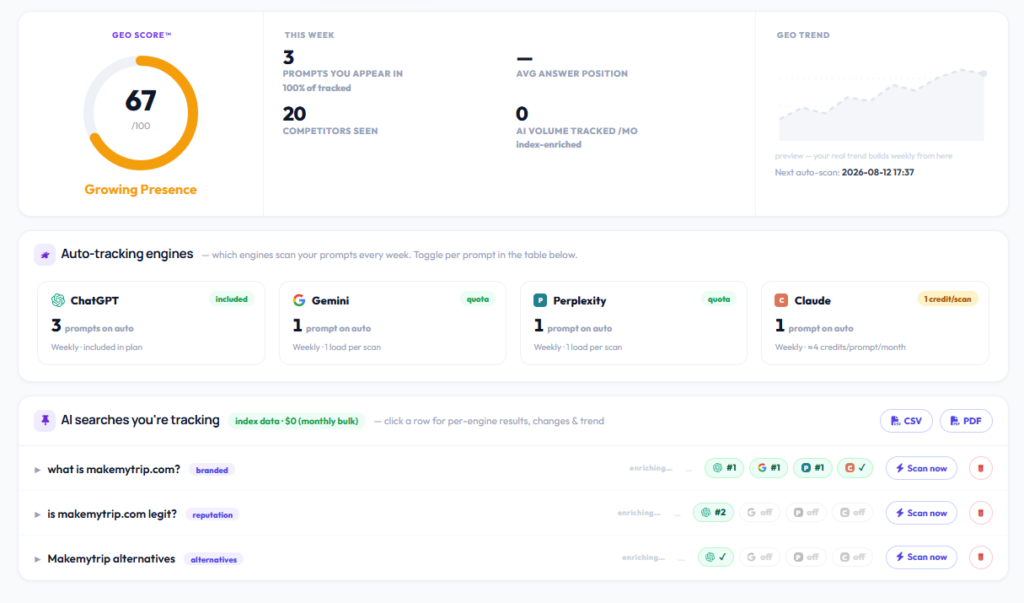
The engine panel is worth understanding before you buy, because the engines are metered differently:
| Engine | Availability on our plan | Cadence |
|---|---|---|
| ChatGPT | Included in plan | Weekly, always on |
| Gemini | Quota-based | Weekly · 1 load per scan |
| Perplexity | Quota-based | Weekly · 1 load per scan |
| Claude | 1 credit per scan | Weekly · ≈4 credits/prompt/month |
ChatGPT runs by default and can’t be toggled off; the other three are per-prompt toggles you switch on where they matter. That’s a sensible design — you’re not burning Claude credits on prompts where Claude isn’t your buyers’ engine — but it does mean the “five engines” headline requires reading the fine print on cost. Budget accordingly if you want all four running on every prompt.
The feature that impressed us most
Scan-over-scan diffing. Expand any tracked prompt and SignalSumo shows the previous scan and the current scan side by side, with an explicit change summary above them.
On the branded prompt “what is makemytrip.com?”, between 6 and 7 August our account logged: position held at #1, with Deep Kalra, Goibibo and redBus entering the answer, and Founded, Headquarters, Services and Related brands leaving it. Entered items are tagged green, departed items struck through in red. GEO score for that prompt held at 92 across both scans.
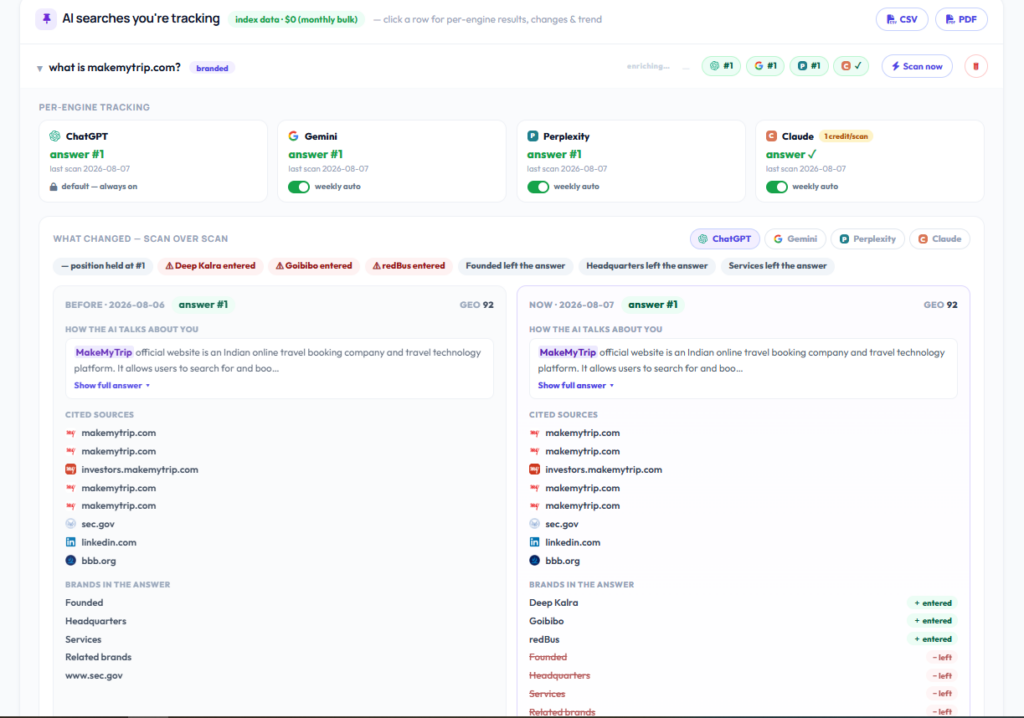
That is the difference between a tool that tells you where you are and one that tells you what changed and when. For anyone trying to attribute AI visibility movement to work they shipped, this is the view that makes it possible.
The cited sources panel is equally practical. For that same prompt, ChatGPT drew on makemytrip.com (multiple pages), investors.makemytrip.com, sec.gov, linkedin.com and bbb.org. That’s not a vague “improve your authority” recommendation — it’s a specific list of the properties shaping how an AI describes the brand.
How to read the results
| Pattern | Diagnosis | Action |
|---|---|---|
| Consistently absent across engines | Not in the consideration set | Off-site problem. Content alone won’t fix it |
| Present in one engine, absent in others | Engines draw on different sources | Identify what the winning engine cites, replicate elsewhere |
| Present but low position | A fallback, not a first choice | Strengthen category association |
| Oscillating week to week | Marginal inclusion — on the boundary | Strongest opportunity in your dataset. Small gains tip marginal cases |
| Brands entering the answer | Competitive set shifting | Check what changed for them — this is an early warning |
| Neutral sentiment | Perception issue, not visibility | Audit what the cited sources say |
The oscillation pattern deserves emphasis. Prompts where a brand flickers in and out are the highest-ROI targets, because the model already treats it as plausible and needs only a nudge. Most teams chase prompts where they’re entirely absent — the hardest to win. Sorting tracked prompts by volatility rather than search volume is a materially better prioritisation strategy, and the timeline data makes it possible.
Which prompts to track
| Prompt type | Template | Why it matters |
|---|---|---|
| Category best | “best [category] for [segment]” | Highest commercial intent |
| Competitor alternative | “alternatives to [competitor]” | Buyers actively switching |
| Constrained | “cheapest [category] with [feature]” | Narrow, winnable, qualified |
| Head-to-head | “[you] vs [competitor]” | Directly shapes purchase decisions |
| Use-case | “what should I use to [job]” | Where challengers realistically win |
| Reputation | “is [your brand] legit / any good” | The one most teams forget |
SignalSumo auto-tags prompts by type — our test account showed branded, reputation and alternatives labels applied automatically — which makes portfolio-level reporting easier than tagging by hand.
Capacity
15 tracked prompts on Mid, 75 on Pro, 100 on Agency. Weekly auto-scans with on-demand “Scan now” available per prompt.
Our verdict
The best implementation of AI visibility tracking we’ve used at this price point. Live answers, cited sources, competitor detection and scan-over-scan diffing in one view. If you buy SignalSumo for one thing, buy it for this.
→ SignalSumo AI Prompt Tracker
SignalSumo AI Prompt Research
What it is
Where the Prompt Tracker monitors prompts you’ve chosen, AI Prompt Research finds them — surfacing the real questions people ask AI about a topic, with volume, trend and cited-source data attached.
What we found
Running “book flight tickets” returned 441 prompts against a topic AI volume of 369.5K/month, segmented into 2 rising, 4 falling and 19 stable across the loaded set. Individual prompts carried their own volumes — “book flight ticket make my trip” at 110.0K/mo, “book flight tickets to dubai” at 22.2K/mo — each with a sparkline trend and a source count.
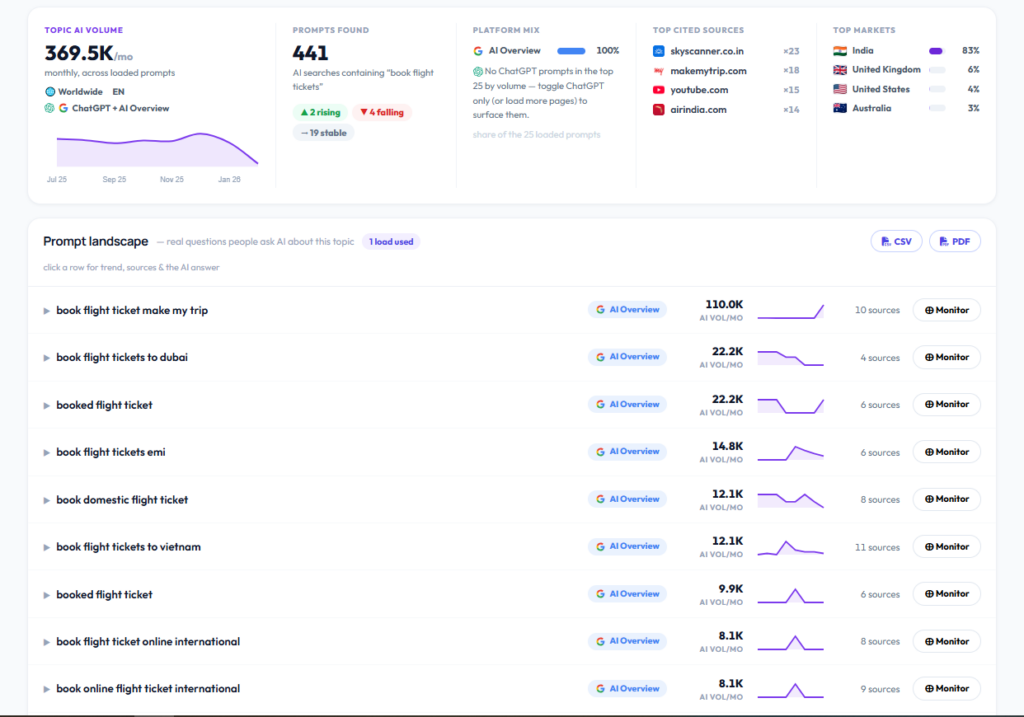
The top cited sources panel is the most commercially useful thing here. For that topic it returned skyscanner.co.in (×23), makemytrip.com (×18), youtube.com (×15) and airindia.com (×14) — an evidence-based digital PR target list for anyone competing in flight booking. Getting cited on four specific properties is a tractable quarterly project. “Build more authority” is not.
One honest note on platform mix. Our search returned a platform mix of 100% AI Overview, with SignalSumo itself flagging: no ChatGPT prompts in the top 25 by volume — toggle ChatGPT only, or load more pages, to surface them. We appreciated that the tool told us this rather than presenting a partial picture as complete, but it does mean default results can skew heavily to one engine depending on topic. Use the platform toggle deliberately rather than accepting the default view.
Every discovered prompt has a Monitor button that adds it directly to the Prompt Tracker, and the whole landscape exports to CSV and PDF. That discovery-to-monitoring handoff is one of the cleanest workflow connections in the platform.
Our verdict
Solves the hardest practical problem in AI-search work — knowing which prompts are worth tracking — with real demand data rather than guesswork. The cited-sources output alone justifies the tool.
→ SignalSumo AI SEO Tools · Free AI Rank Checker
SignalSumo AI Competitor Research
What it is
Head-to-head brand benchmarking across AI engines: AI Share of Voice, per-engine strength, per-market breakdown, and the prompts rivals win.
What we found
Comparing makemytrip.com against agoda.com returned a Share of AI Voice split of 48% / 52%, with makemytrip at 233.2K AI mentions against agoda’s 253.2K. Interestingly, makemytrip carried substantially higher AI volume (1,168.6M/mo vs 352.0M/mo) despite fewer mentions — the kind of divergence that’s worth investigating rather than glossing over.
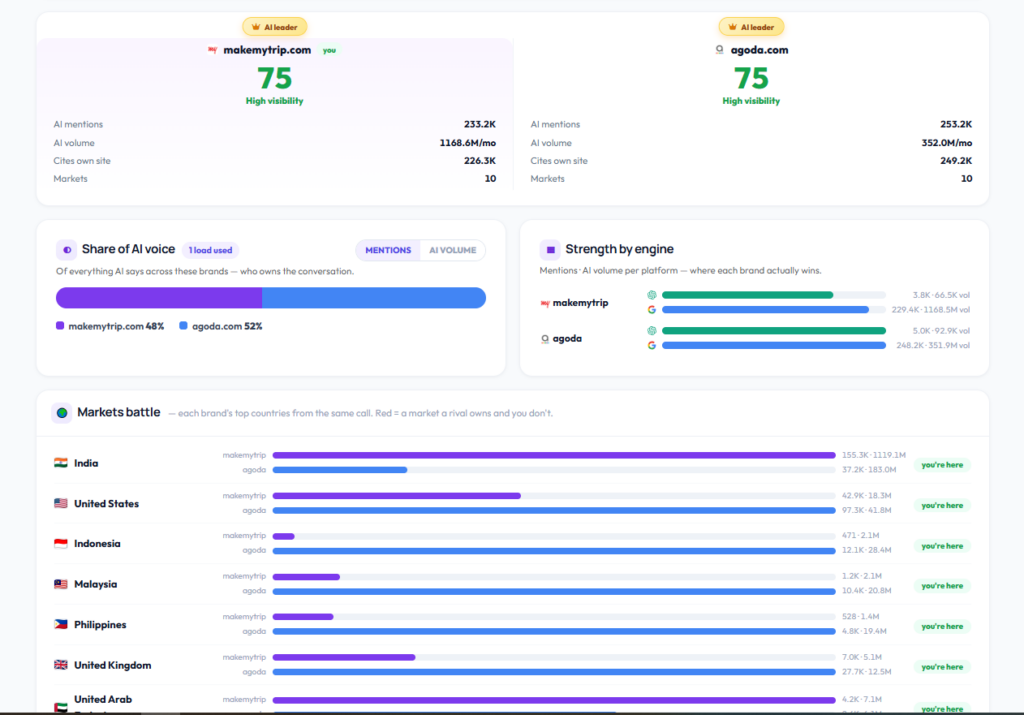
The Markets Battle panel is the part we’d use most. It breaks visibility down by country and flags in red any market a rival owns and you don’t. For makemytrip the picture was immediately legible: dominant in India (155.3K vs 37.2K mentions), competitive in the UK, but clearly behind in Indonesia (471 vs 12.1K), Malaysia, the Philippines and the United States. For a travel brand planning market expansion, that’s a strategy input, not just a metric.
Strength by engine broke each brand’s mentions and volume down per platform, making it easy to see where each competitor actually wins rather than assuming a single overall ranking tells the story.
One limitation worth knowing
Both brands in our comparison returned an identical visibility score of 75, and both were labelled “AI leader.” When two competitors score the same and share the top badge, the headline comparison loses its edge — you have to drop into Share of Voice and the market breakdown to find the real differences. Those lower panels do the work, but the top-line summary was less decisive than we’d have liked.
Our verdict
Strong, and the market-level breakdown is genuinely differentiated. The top-line scoring could discriminate more sharply, but the underlying panels give you what you need.
→ SignalSumo AI Competitor Research
SignalSumo AI Visibility Checker & GEO Score
What it is
A diagnostic scoring how clearly AI systems understand your brand, across five weighted factors: brand and entity clarity, citation strength, content authority, structured data and extractability, and AI recommendation probability.
Scores map to three tiers: AI-Hidden (0–49), AI-Visible (50–79) and AI-Optimized (80–100).
What we found
Our test account returned a GEO Score of 67 — “Growing Presence” — with 3 prompts appearing out of 3 tracked (100%), 20 competitors seen, and a next auto-scan date scheduled a week out. The GEO trend chart is explicitly labelled as a preview until enough weekly scans accumulate, which is honest framing rather than a fabricated trend line.
Per-prompt GEO scores also appear inside the tracker — the branded makemytrip prompt scored 92 — so you get both a portfolio-level number for reporting and prompt-level numbers for diagnosis.
How to interpret it
| Result | Diagnosis | Action |
|---|---|---|
| 0–49 (AI-Hidden) | Models can’t resolve who you are | Fix entity fundamentals first: Organization schema, real About page, consistent naming, sameAs links |
| 50–79 (AI-Visible) | Understood but not preferred | Shift to citation acquisition — get named on sources models already consult |
| 80–100 (AI-Optimized) | Structurally strong | Move to prompt-level competition and defence |
| Strong score, few AI mentions | Site is fine; reputation isn’t | Off-site problem. Pursue placement on cited sources, not more owned content |
That final row is the most useful diagnostic pattern the tool produces, and one worth internalising: a strong GEO Score with low AI presence means your house is in order but nobody outside is discussing you. The remedy is digital PR, not another blog post.
Limitation to note
The GEO Score is a proprietary model of AI citability, as every score of this kind necessarily is — no AI provider publishes its citation criteria. Read it as directional and lean on the factor breakdown for decisions.
→ SignalSumo AI Visibility Checker · GEO Tracking Software
SignalSumo AI Growth Plan
What it is
SignalSumo reads audit results, rankings, competitor gaps, backlink data and AI visibility, then generates a prioritised action plan.
What we found
This was the biggest positive surprise of our testing. Every SEO platform has the same failure mode — the user logs in, sees eight dashboards and tens of thousands of data points, and closes the tab. The constraint was never data availability. It’s “what do I do on Monday?”
The 90-day growth plan reads across tools in a way a person can only do by opening six tabs and holding the connections in their head. On sites we know well, the prioritisation was correct — urgent items ranked above cosmetic ones, and the sequencing reflected genuine dependency rather than an arbitrary checklist.
For a small business owner, a marketing generalist, or anyone who isn’t a full-time SEO specialist, this may be the single most valuable feature in the platform, because it converts a tool that would otherwise be underused into one that gets acted on.
Capacity: 5 plans/month on Mid, 10 on Pro, 35 on Agency.
Our verdict
Treat the output as a strong first draft rather than gospel — it can’t know your business context — but on our test sites it consistently got the ranking right. That’s more than we can say for most auto-generated SEO recommendations.
→ SignalSumo AI SEO Growth Plan
AI Intelligence Center, Visibility Tracker and Content Tools
AI Intelligence Center is the live query engine underneath the AI suite — enter a domain and a prompt and get the answer, position and competitors back in seconds. It’s the “show me right now” tool for stakeholder questions and client demos, and the natural discovery step before committing prompts to ongoing tracking.
AI Visibility Tracker (GEO Rank Tracker) is the rolled-up executive view: composite GEO Score and AI Share of Voice across all tracked prompts. Same data as the Prompt Tracker, different altitude. Use it for reporting; use the Prompt Tracker for diagnosis. When the composite moves, drop into prompt level to find out which prompts caused it — a flat composite can conceal five prompts improving and five declining.
Content Optimizer and AI Content Writer provide live content scoring, keyword and heading suggestions, readability grading, and article generation graded for GEO readiness. The live GEO grading is the useful part: writing against extractability and schema requirements during drafting beats retrofitting them months later. Our advice is to use the Optimizer to structure content written by people who know the subject — expert input with AI-assisted structuring, not the reverse.
A note on naming. The AI Visibility Checker, AI Visibility Tracker and AI Intelligence Center have overlapping names and related-but-distinct functions. All three are useful; it took us longer than it should have to internalise which was which. Clearer naming would help new users orient faster.
PART TWO: THE TRADITIONAL SEO TOOLS
SignalSumo is a genuine all-in-one SEO platform, not an AI visibility product with SEO attached. This is the part of the review that establishes it.
SignalSumo Website Audit
What it is
A technical SEO crawler that visits a site page by page, follows internal links, and reports issues by severity — while scoring AI readiness in the same pass.
What we found
We maxed the crawler at 100,000 pages on a single domain. It completed in approximately two hours with JavaScript rendering enabled, running in the background with no supervision needed. JS rendering worked correctly on JavaScript-heavy sites — the specification most likely to underperform in practice, and the one we were most sceptical about going in.
That’s a solid result. Background crawling with pause and resume means no desktop application to babysit and no local memory ceiling, which matters on large ecommerce sites.
Specification
- Up to 100,000 pages (configurable: 200 / 1,000 / 5,000 / 10,000 / 50,000 / 100,000)
- 50+ checks per page — status codes, thin content, duplicate/missing titles, metas, H1s, load time, page size
- JavaScript rendering via headless browser
- Crawl depth control to 10 levels, with subdomain toggles
- Background crawling with pause and resume
- PageSpeed Insights and Core Web Vitals automatically — Lighthouse scores, LCP/INP/CLS, desktop and mobile separately
- Critical vs Warning grouping with affected page counts and code-level locations
- PDF and CSV export
The GEO pillars scored in every audit
| Pillar | What it checks |
|---|---|
| Entity clarity | Brand naming, social profile links, Organization markup |
| FAQ coverage | FAQ pages, collapsible details, conversational headings |
| Schema coverage | Organization, FAQPage, BreadcrumbList, Person markup |
| AI extractability | H1–H3 hierarchy, sentence length, active voice, content depth |
| E-E-A-T signals | Author bios, external references, trust policies |
Returning an SEO Health score and a GEO score from the same crawl is the right design. The pages are the same pages and the fixes overlap heavily. Splitting them across two products — as several larger competitors do — creates artificial separation between work that should be sequenced together.
How to interpret the findings
The most common error with any audit tool is treating the issue count as a list to be driven to zero. Severity grouping exists to counteract that.
| Finding | Priority | Action |
|---|---|---|
| 500 server errors | Highest — same day | Application or server fault. Involve engineering |
| 404s on pages with inbound links | High | Cross-reference with the broken-backlink report, 301 to closest match |
| Missing page titles | High, trivial to fix | Best effort-to-impact ratio in any audit |
| Redirect chains 3+ hops | Medium-high | Collapse to single hops |
| Missing H1 | Medium | Affects AI extractability as well as classic SEO |
| Thin content under 300 words | Depends on page type | Category and utility pages are legitimately short |
Our verdict
A capable, well-specified crawler that handled our heaviest test without complaint. Free weekly monitoring after every audit is a genuine differentiator at this price.
→ SignalSumo Website Audit Tool · Try the crawler demo
SignalSumo Backlink Intelligence
What it is
Full inbound link profile analysis — volume, authority, quality, toxicity, anchor distribution, Class-C network analysis, velocity, geography and page-level authority mapping.
What we found
The depth here exceeded our expectations for a platform at this price. Running nike.com returned a Backlink Health score of 85/100 built from Authority 83, Risk 12, Follow 84% — across 183.8K referring domains (169,732 root), 24.5M backlinks, 66.4K referring IPs spanning 29,875 Class-C subnets, and 1.8M broken links across 1.38M dead pages.
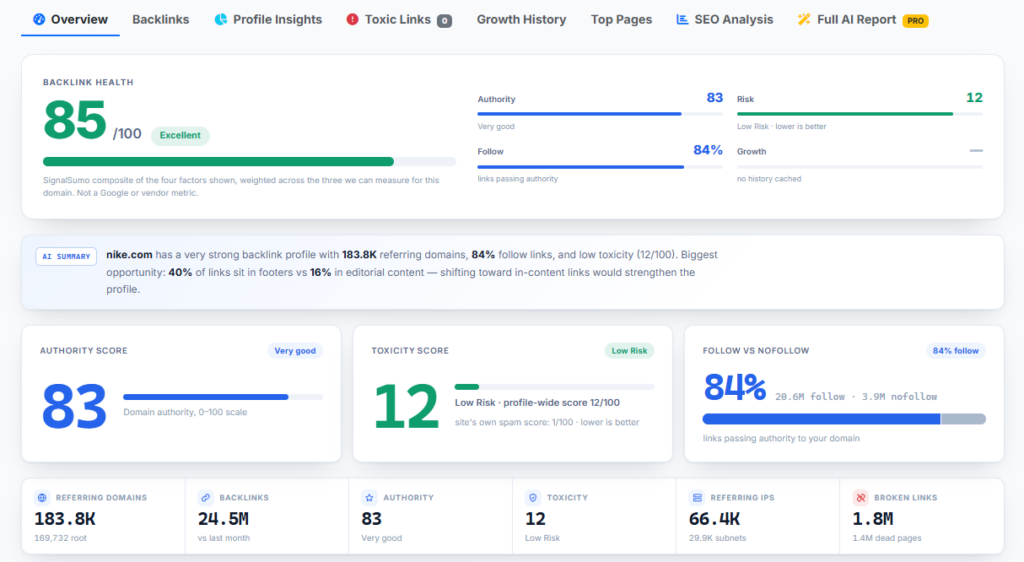
The AI summary is the part we’d actually use. For nike.com it read: a very strong profile with 183.8K referring domains, 84% follow links and low toxicity, with the biggest opportunity being that 40% of links sit in footers versus 16% in editorial content — shifting toward in-content links would strengthen the profile.
That’s a specific, actionable diagnosis rather than a restatement of the metrics above it. It’s the sort of read a competent SEO would give you after twenty minutes with the data.
We also want to credit something small but meaningful: SignalSumo labels its Backlink Health score as “a SignalSumo composite of the four factors shown, weighted across the three we can measure for this domain. Not a Google or vendor metric.” Vendors rarely state the limits of their own metrics that plainly.
Profile Insights
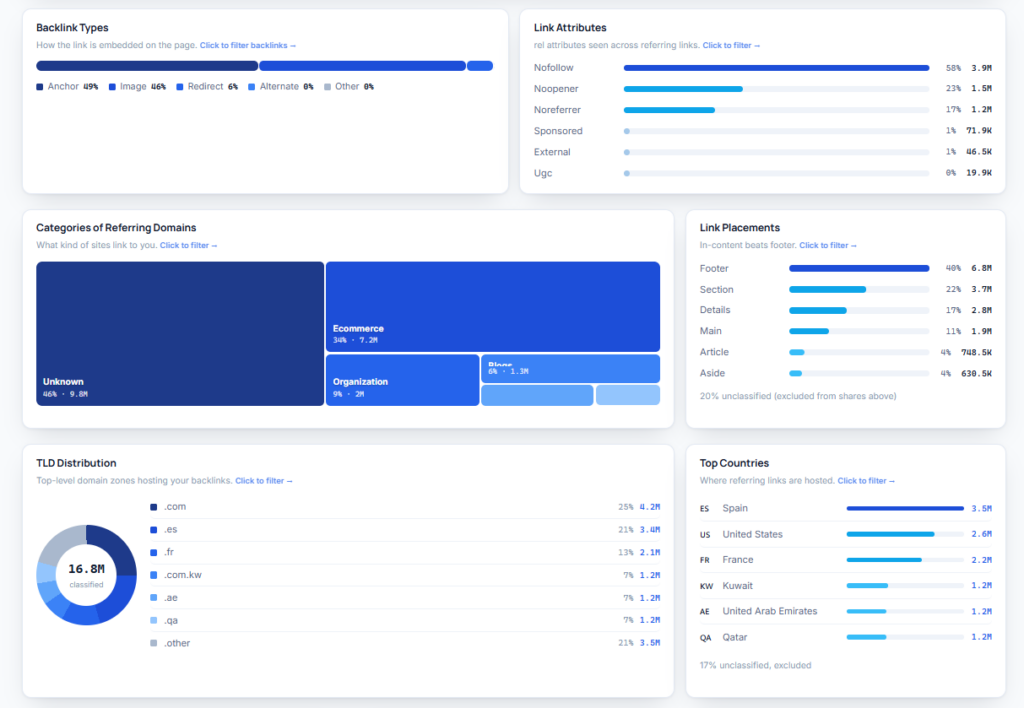
The breakdowns are unusually granular: backlink types (49% anchor, 46% image, 6% redirect), link attributes (58% nofollow, 23% noopener, 1% sponsored, 0% UGC), a categories treemap, link placements distinguishing footer (40%) from section (22%), details (17%), main (11%) and article (4%), plus TLD zone distribution and top countries. Every panel is click-to-filter.
The link placement data is the differentiator. Knowing that 40% of a profile sits in footers versus 4% in article body is a materially different insight from knowing the total link count, and most tools at this price don’t surface it.
Backlink Audit
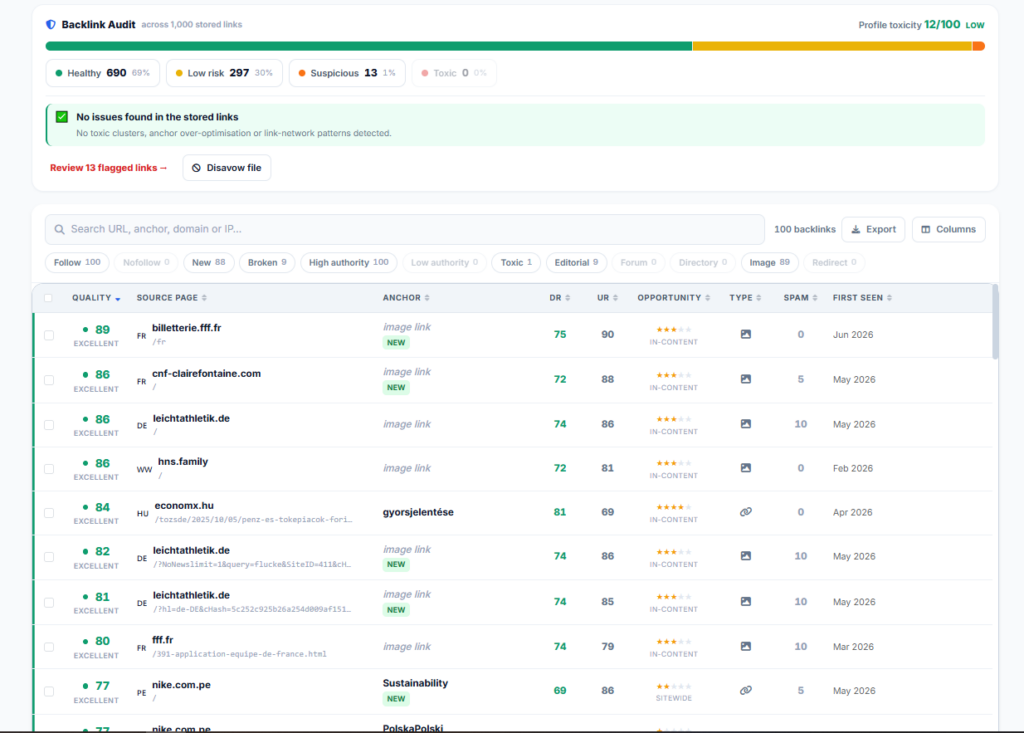
The audit graded our sample at 690 healthy (69%), 297 low risk (30%), 13 suspicious (1%), 0 toxic, with profile toxicity 12/100 and a one-click disavow file export. The table carries quality tier, DR, UR, opportunity stars, link type, spam score and first-seen date, filterable by follow status, new, broken, high authority, editorial, forum, directory, image and redirect.
One important caveat: the audit runs across 1,000 stored links, not the full 24.5M-link profile. For a site of that size, that’s a sample — a useful one, and the filters make it navigable, but don’t read “0 toxic” as a whole-profile guarantee.
A note on the disavow export: use it deliberately rather than enthusiastically. Google’s own guidance is that most sites never need a disavow file, and over-disavowing legitimate links causes real harm. Treat SignalSumo’s generated file as a reviewed starting point, not a one-click action.
Network and Class-C analysis
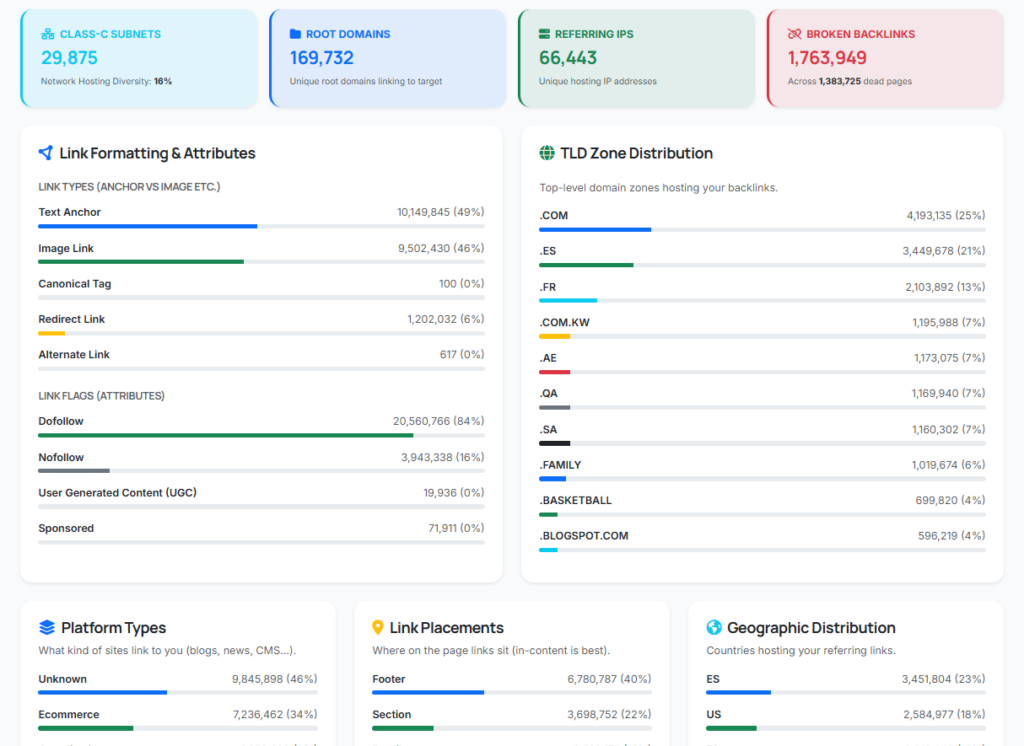
Class-C subnet analysis with a network hosting diversity percentage is a feature we’d normally expect from tools costing several times more. SignalSumo publishes its authority weighting — unique Class-C IPs at 50%, referring domain DR at 30%, link equity volume at 20%, reciprocal loops excluded — and the heavy Class-C weighting is a defensible anti-manipulation choice.
Growth History
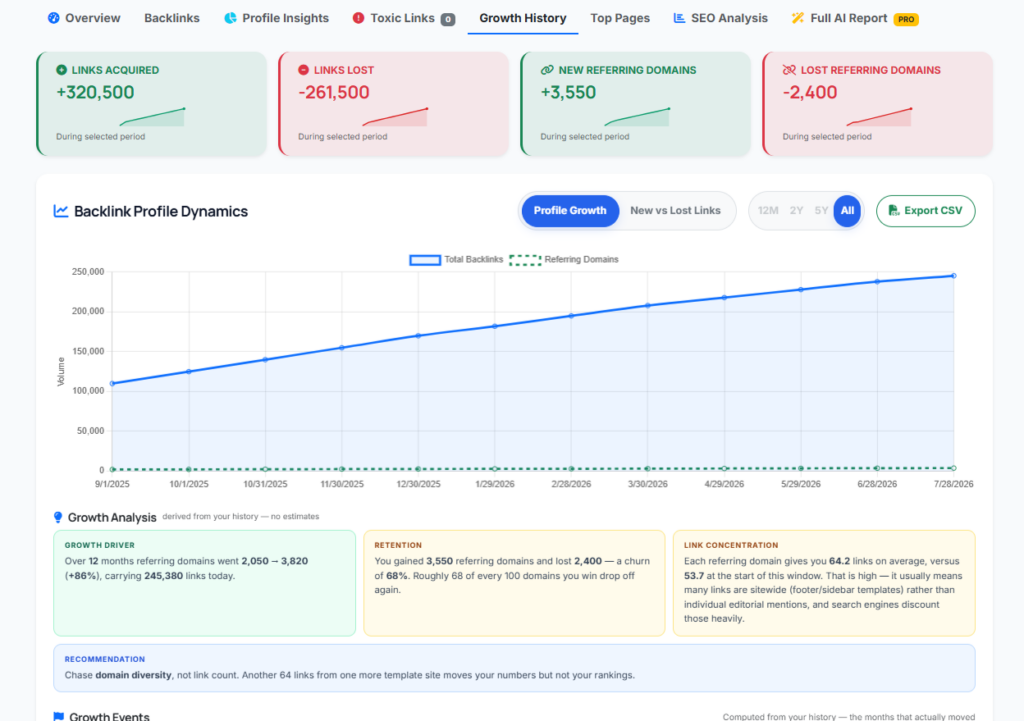
Across 12M/2Y/5Y/All views, one test domain showed +320,500 links acquired against -261,500 lost, and +3,550 new referring domains against -2,400 lost. The automatic Growth Analysis was the strongest part:
- Growth driver: referring domains went 2,050 → 3,820 (+86%) over 12 months, carrying 245,380 links today
- Retention: 68% churn — roughly 68 of every 100 domains won drop off again
- Link concentration: 64.2 links per referring domain on average, versus 53.7 at the start of the window, flagged as high and typically indicating sitewide footer or sidebar templates that search engines discount heavily
- Recommendation: chase domain diversity, not link count — another 64 links from one more template site moves your numbers but not your rankings
That’s a genuinely sophisticated read. Most tools would show the same chart and leave the interpretation to you.
Top Pages
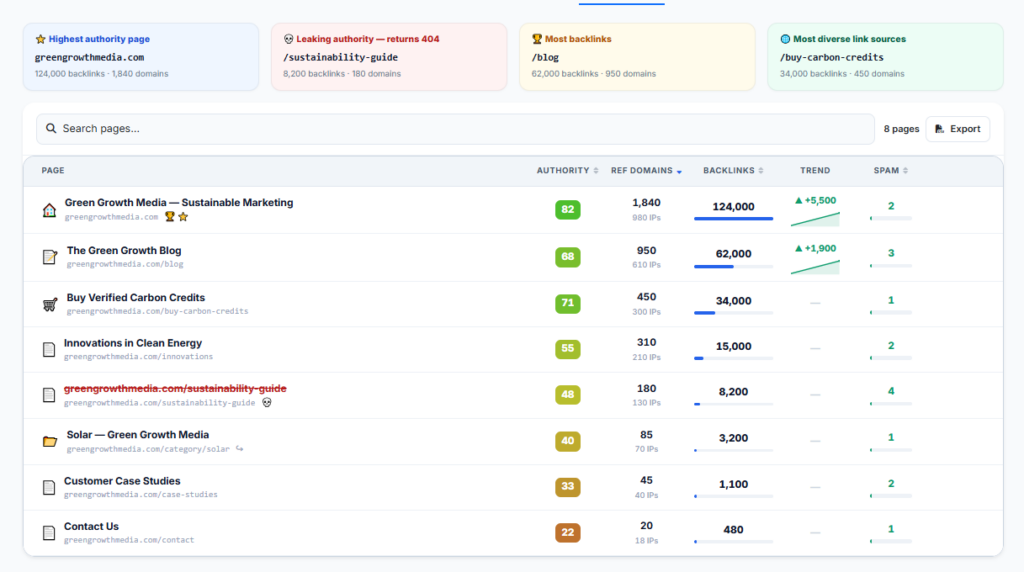
The Top Pages view identifies your highest-authority page, your most-backlinked page, your most link-diverse page, and — most usefully — the page leaking authority because it returns a 404. Dead URLs still carrying inbound links are the highest-ROI item in any link report, and having them surfaced automatically rather than cross-referenced by hand saves real time.
On index depth
We ran domains through SignalSumo that we also hold data on in Ahrefs and Semrush, and SignalSumo returned profiles in the millions of links with no obvious thinness. That said, we did not run a controlled like-for-like benchmark, and we won’t claim one. Established platforms have had a decade-plus to build their indexes and that history is real.
Our honest position: for the SMB, freelance and small-agency work this platform targets, the depth we saw is more than sufficient. Teams whose entire business is competitive link building at scale should keep a specialist index alongside — but that’s true of most all-in-one suites, not a specific criticism of SignalSumo.
Our verdict
Excellent report architecture and one of the strongest parts of the platform. Class-C analysis, link placement data, growth interpretation and 404 leak detection at $249/month represent real value.
→ SignalSumo Backlink Checker · Backlink monitor demo
SignalSumo Backlink Gap and Backlink Monitor
Backlink Gap
Tool page: SignalSumo Backlink Gap Tool
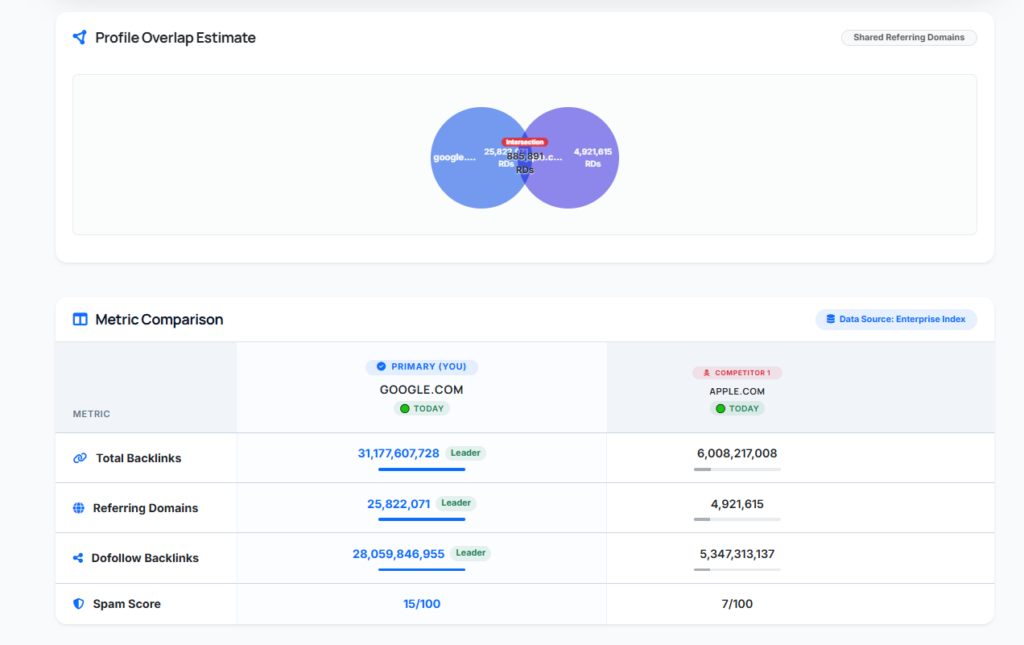
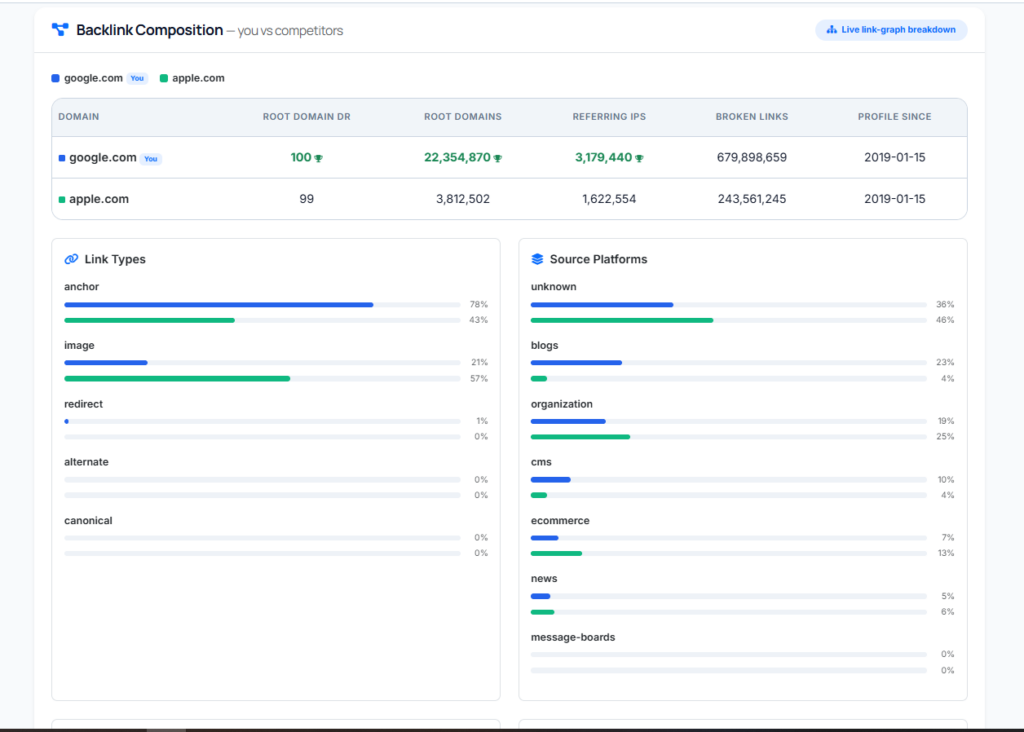
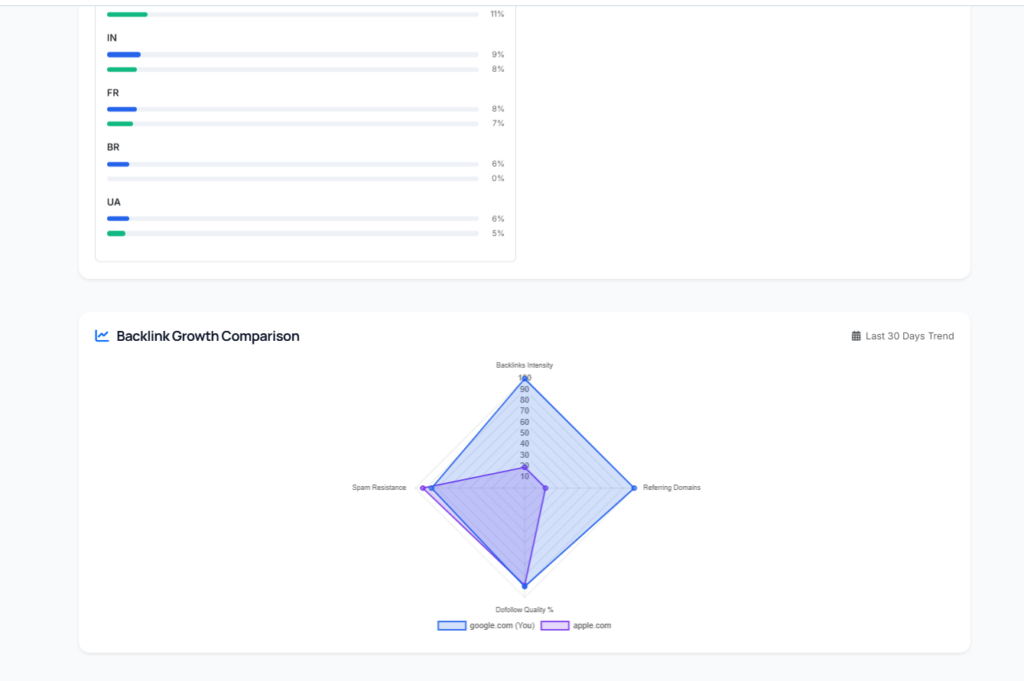
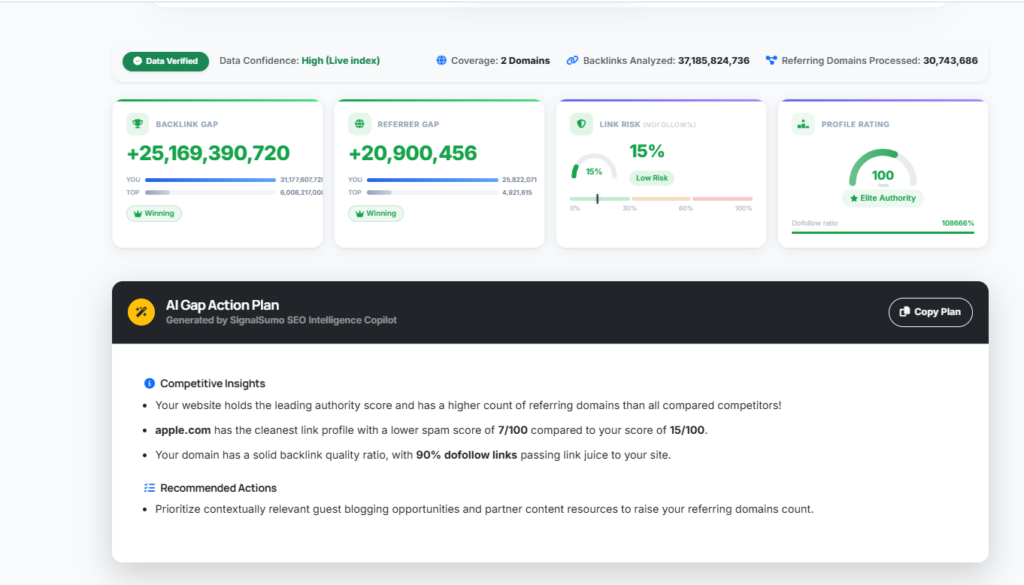
The gap tool runs a live comparison with a data confidence indicator — our google.com vs apple.com test reported 37.1 billion backlinks analysed across 30.7 million referring domains, flagged “Data Verified · High (Live index)”.
The output includes a Venn-style profile overlap estimate showing shared referring domains, a metric comparison table with leader flags, backlink composition breakdowns (link types and source platforms side by side), geographic distribution, and a radar chart comparing backlinks intensity, referring domains, dofollow quality and spam resistance.
Two honest observations. First, we hit a clear display bug: the Profile Rating card reported a dofollow ratio of 108,666%. The underlying numbers are fine — 28.06B dofollow of 31.18B total is 90% — but the percentage rendering is broken. Cosmetic rather than data-corrupting, but it’s the kind of thing that undermines confidence in a client-facing screenshot.
Second, the AI Gap Action Plan was the weakest AI output we encountered. Its competitive insights correctly identified the authority leader and the spam score comparison, but its recommended action — prioritise contextually relevant guest blogging opportunities and partner content resources to raise your referring domains count — is generic advice that doesn’t use the specific gap data sitting directly above it. The Growth History analysis in the main backlink tool is considerably sharper; we’d like to see the same quality applied here.
Backlink Monitor
Tool page: SignalSumo Backlink Monitoring
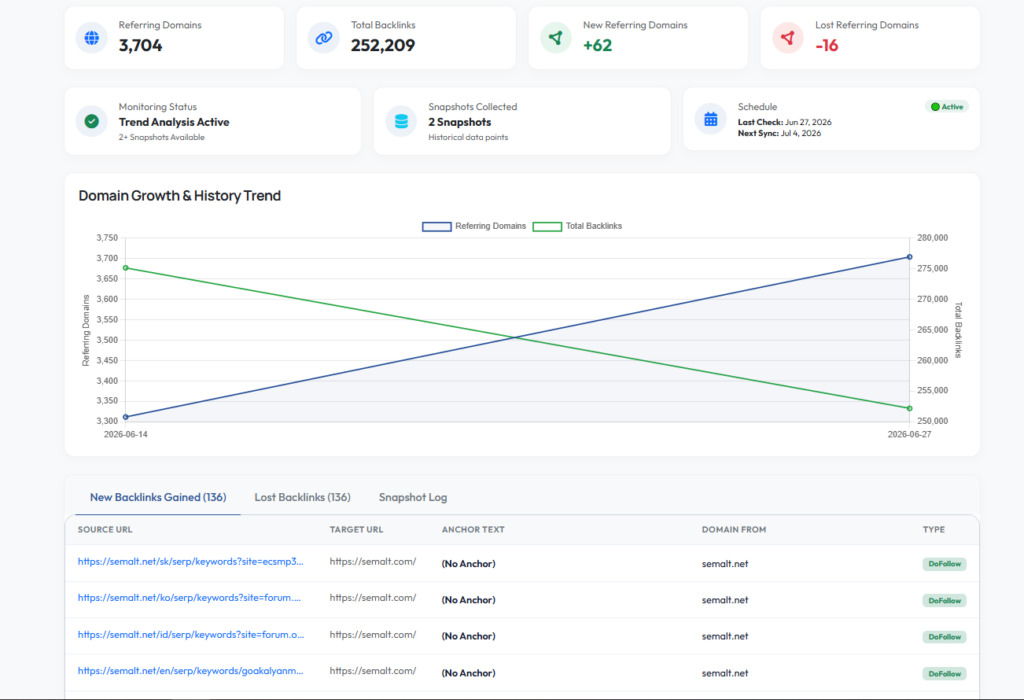
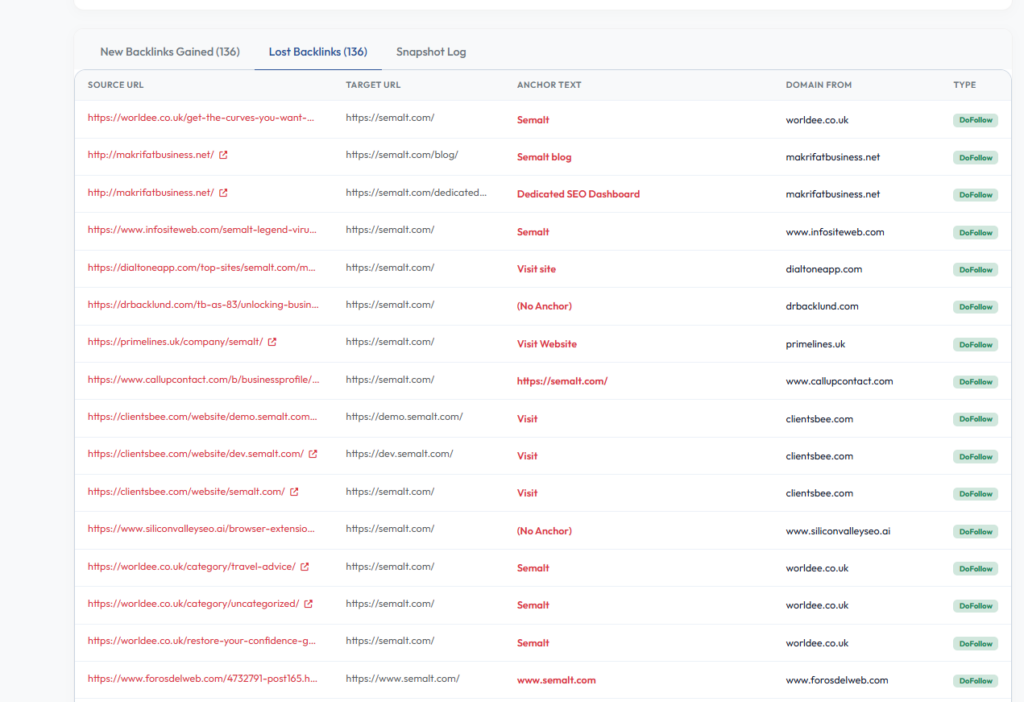
Monitoring tracked 3,704 referring domains and 252,209 total backlinks on a test domain, reporting +62 new and -16 lost referring domains, with full tables of gained and lost backlinks including source URL, target URL, anchor text, source domain and follow type.
The caveat here is expectation-setting rather than a flaw: monitoring needs snapshots to accumulate. Our account showed “2 Snapshots Collected,” which produces a two-point trend line — technically a chart, but not yet informative. Sync runs weekly, so budget roughly two months before the trend view earns its place. Set it up on day one and let it build.
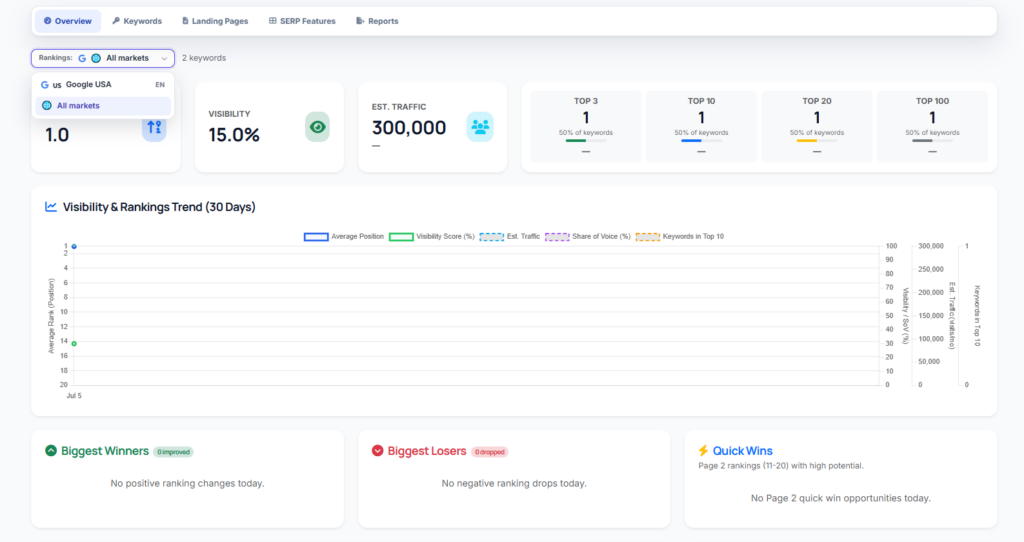
SignalSumo Rank Tracker
What it is
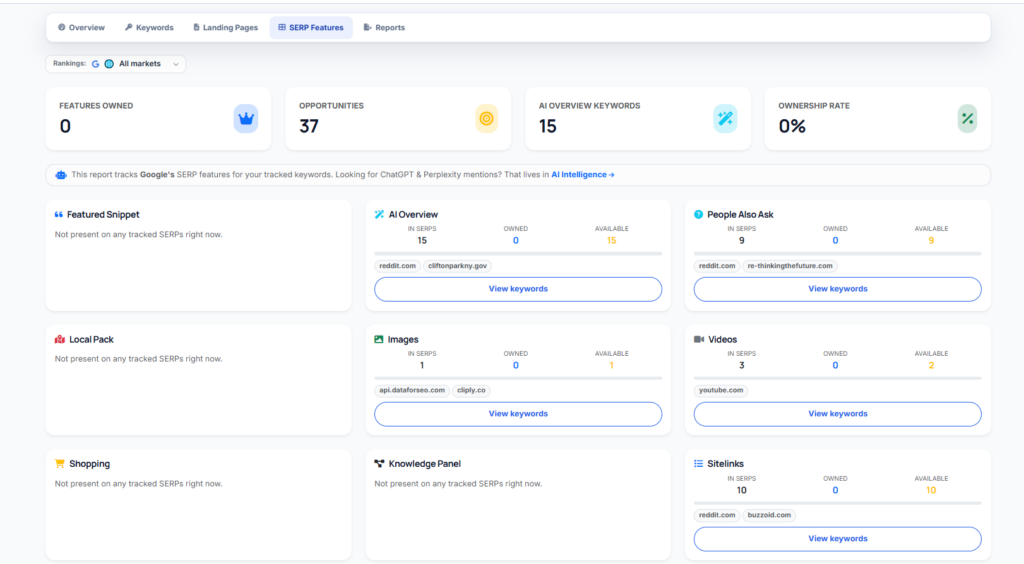
Keyword position tracking by location and device, across Google, Bing, Yahoo and localised variants, with SERP feature monitoring and alerts.
What we found
Location granularity goes down to postal codes, cities and regions across hundreds of countries, with mobile and desktop tracked independently. Keyword capacity is 100 on Mid, 750 on Pro, 2,000 on Agency, with SERP depth to Top 50 on higher plans.
One point to be clear about for prospective buyers: SignalSumo’s marketing has in places described daily tracking it can also be set to weekly or monthly as per your convinience. The plan comparison table is the accurate document. Weekly cadence is perfectly serviceable for the majority of SEO work — daily checking genuinely matters only for volatile commercial terms, active migrations or algorithm-update monitoring.
The strategic argument
A now-routine scenario: a keyword holds position 4, impressions hold steady, clicks fall thirty percent. In a traditional rank tracker this looks like a mystery.
Cross-referenced against SERP feature tracking and AI visibility data, the explanation is usually immediate — an AI Overview is answering above the listing and the click never happens. That’s not a ranking problem, and no on-page work fixes it. This is the clearest practical case for having both datasets in one platform, and it’s the scenario we found ourselves using SignalSumo for most often.
How to interpret the data
| Pattern | Meaning | Action |
|---|---|---|
| Single keyword drops, others stable | Page-level issue | Check for technical faults, cannibalisation, lost links |
| Broad decline | Site-wide or algorithmic | Check audit health, GSC, update chatter |
| Positions 8–15, stable | Highest-value opportunity band | Small improvements yield disproportionate CTR gains |
| Ranking holds, traffic falls | SERP features absorbing clicks | Cross-reference AI visibility data |
| Mobile/desktop diverging | Mobile-specific problem | Check rendering, CWV, mobile SERP layout |
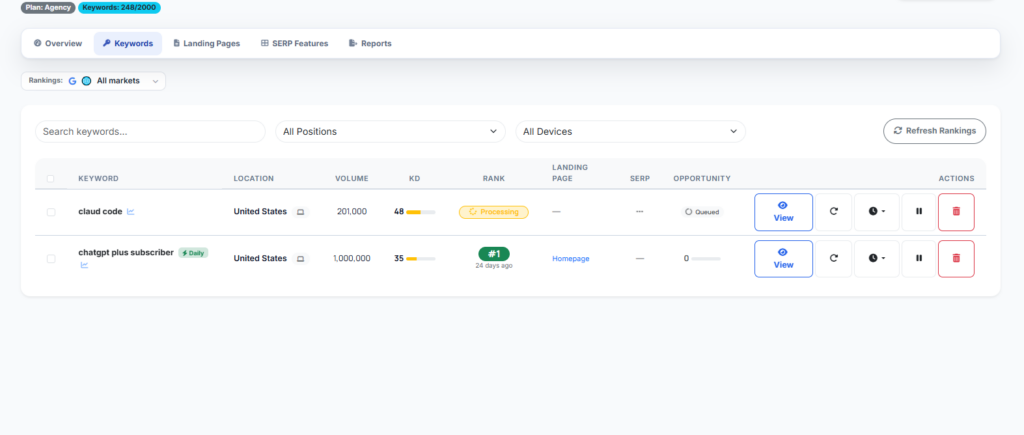
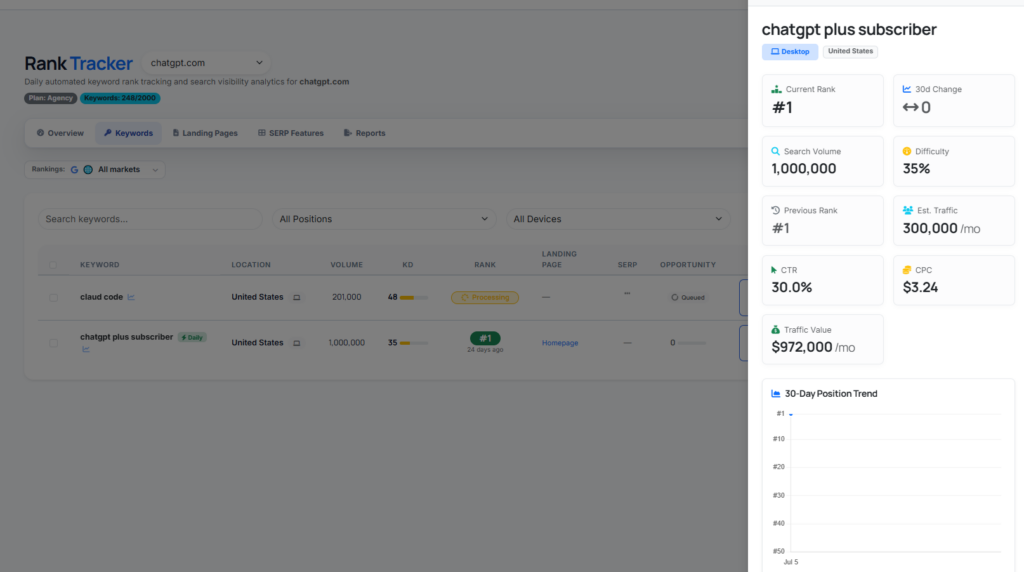
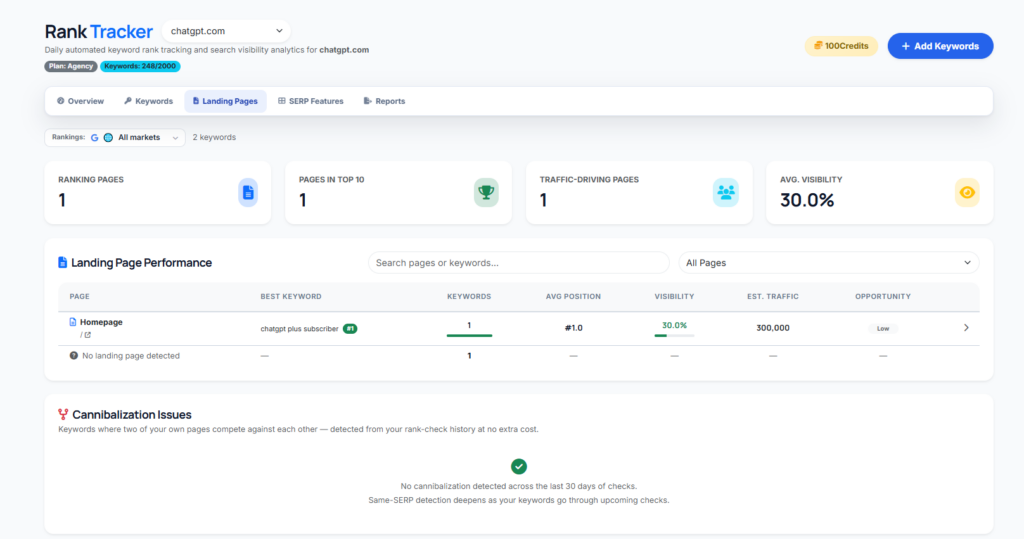
→ SignalSumo Rank Tracker · Rank tracker demo
SignalSumo Keyword Research and Competitor Research
Keyword Research covers volume, difficulty and question discovery across 175+ country databases. Capacity is 25 searches/month on Mid, 75 on Pro, 200 on Agency.
Its most valuable property within SignalSumo is what it connects to:
Google keyword → conversational question → AI prompt → AI visibility monitoring
Question-format keywords are the raw material for AI prompts — people type shorthand into Google and full sentences into assistants, but intent is identical. Combined with AI Prompt Research, this gives you two independent routes to a defensible prompt set, which is the hardest part of getting started with AI-search work.
Interpretation notes: difficulty scores are relative, not absolute — compare SignalSumo scores to other SignalSumo scores rather than to a competitor’s KD. Volume figures are estimates industry-wide; use them for prioritisation, not forecasting.
Competitor Research handles keyword overlap and gap analysis with automatic competitor discovery refreshed every 30 days. Capacity: 10 reports/month on Mid, 30 on Pro, 75 on Agency; 3 competitors per analysis on Mid and Pro, 5 on Agency.
The dual-lens advantage is the real story here:
| Lens | The question | The tool |
|---|---|---|
| Search engine competition | Who ranks for the queries I care about? | Competitor Research |
| AI competition | Who gets recommended when buyers ask assistants? | AI Competitor Research |
These frequently produce different answers, and that divergence is strategically important. Monitoring only one lens means managing half your competitive exposure without knowing which half.
Auto-discovery is more useful than it sounds, because the sites competing with you for search visibility are frequently not the companies competing with you for revenue — publishers, review sites and adjacent-category players often occupy the SERPs you want.
→ Keyword Research Tool · Competitor Analysis
SignalSumo Local SEO
What it is
Local pack rankings, Google Business Profile accuracy, review monitoring and citation tracking, plus a Local SEO Grid and a Local SEO AI Plan.
What we found
The Local SEO Grid was a highlight — simple, clean and genuinely powerful. 3×3, 5×5,7×7 Grid-based local rank visualisation is the correct way to present local data, because local pack results vary street by street. A business can rank first from one postcode and be invisible from the next suburb, and city-level tracking averages away exactly the variation that determines whether customers find you.
Why local businesses need both surfaces
“Best [service] near me” is now asked of AI assistants roughly as often as it’s typed into a search box. Asked to recommend a plumber or a dentist, an assistant returns a shortlist of named businesses — not a map with twenty pins.
Local businesses arguably have more to gain from AI visibility monitoring than any other category, because AI answers compress choice so aggressively at the local level. They’re also among the least likely to be watching it. Having local grid tracking and AI prompt tracking in one platform, at one price, is a real advantage for agencies serving local clients.
Practical example
A three-location dental practice. Track local pack rankings across each catchment to find visibility dead zones. Monitor GBP accuracy and review velocity per location. Simultaneously track prompts: “best dentist in [area],” “emergency dentist near me [area].” The combination shows where the practice is findable and where it’s recommended.
→ SignalSumo Local SEO Toolkit · Local SEO Audit
Google Search Console Insights, SEO Monitoring and Uptime
GSC Insights was one of the most useful integrations in our testing. Search Console is the only first-party truth in SEO — volume, difficulty, DR and visibility scores are all models, while impressions and clicks are measured. Blending that into the platform keeps everything else honest.
Two patterns to look for: high impressions with low CTR indicates visible-but-not-compelling, usually a title and meta problem and routinely the fastest traffic win available. Impressions holding while clicks decline is the defining pattern of 2026, frequently an AI Overview absorbing the click — cross-reference against your AI visibility data for the same query.
SEO Monitoring re-crawls a priority page watchlist on a schedule — bi-weekly on Mid, weekly on Pro, every three days on Agency — covering 6 to 15 pages with email digests. SEO regressions are silent: a developer ships a change, a noindex tag reaches production, and nobody notices until rankings fall six weeks later.
Uptime Monitoring performs minute-level checks with instant email alerts on every tier including free. Monitors: 5 on Mid, 10 on Pro, 25 on Agency. This is competitive with dedicated uptime services that charge separately for the same function.
On email alerts generally: we received progress notifications throughout our testing period, and they were well-designed — modern, on-point, and informative rather than noise. It’s a small thing, but it’s the difference between a platform you check and a platform that tells you when to check it.
PART THREE: SIGNALSUMO FOR AGENCIES
| Capability | What it does | Availability |
|---|---|---|
| Multi-project workspaces | Separate projects per client with isolated data | 5 / 10 / 25 |
| White-label reporting | Branded PDF, CSV, HTML with custom logo and colours | Pro and above |
| Client logins | Individual client access to their reporting | Pro and above |
| Scheduled reporting | Automated weekly delivery (every 3 days on Agency) | Mid and above |
| Executive reports | AI-generated executive summaries | Pro and above |
| Audit Embed Widget | Branded lead-capture audit form | 1 (Pro) / 25 (Agency) |
| Team seats | Multi-user access | 2 (Pro) / 5 (Agency) |
| Developer API | REST access with API key management | Pro and above |
What we found
White-labelling works cleanly. We generated Executive Reports for instant white-label output and scheduling, and the results were client-ready as produced — we wouldn’t rebuild them. Branding applied properly, and the scheduled delivery worked without intervention. For agencies, this is the difference between a platform that saves you a day per client per month and one that doesn’t.
API key management worked as expected. Note that API allowances suit periodic reporting rather than continuous data pipelines; teams planning warehouse integration should discuss requirements with SignalSumo before committing.
The consolidation economics
A typical small agency stack — all-in-one suite, technical crawler, rank tracker, backlink index, content tool, AI visibility platform, reporting tool, lead-gen widget — commonly means six to eight subscriptions, six to eight logins, and data in six to eight places requiring manual assembly into a client report each month.
SignalSumo’s Agency plan at $249/month covers all eight. The reporting time saving is where the material benefit sits.
Capacity: 25 projects, 2,000 keywords (~80/client), 100 tracked prompts, 250 AI visibility checks, 30 audits/month, 5 seats. That comfortably supports a 20–25 client roster with AI visibility as a service line. If AI visibility becomes your headline offering across every client, model the 100-prompt allocation against your roster before committing.
The audit embed widget
A branded audit form embedded on your own site: a visitor enters their URL, SignalSumo runs a crawl under your account, and the lead lands in your dashboard. Configuration covers custom labels, colour matching, crawl depth (5–50 pages), four result-display behaviours, four form layouts and GDPR opt-in fields. 25 white-labelled widgets on Agency.
Free audit tools are a proven acquisition channel for SEO agencies, and building one in-house is a meaningful engineering project. Getting it bundled is real cost avoidance.
→ Audit Embed Widget · White-Label Reporting · Developer API · MCP Server
PART FOUR: PRACTICAL WORKFLOWS
Workflow 1 — Launching SEO for a new website
Week 1: Full Website Audit with JS rendering, fixing Critical issues first. Connect Google Search Console immediately so history accumulates. Run the AI Visibility Checker for a GEO baseline — a new site will score AI-Hidden, which is the correct starting point and a valuable before-picture. Run Backlink Intelligence on your own domain.
Week 2: Run Competitor Research using auto-detected suggestions. Run AI Competitor Research against your top rivals and save the market breakdown. Run Backlink Gap against the same rivals and cross-reference — overlapping domains become priority-one outreach.
Week 3: Keyword Research across core topics, harvesting question-format keywords. Run AI Prompt Research on the same topics and use the Monitor button to push high-volume prompts straight into the tracker. Add 20–40 keywords to the Rank Tracker including branded terms.
Week 4: Fix the GEO fundamentals flagged in the audit — Organization schema, About page, author bios, FAQ schema. Generate an AI Growth Plan and work the list. Set up uptime monitoring and scheduled reports.
Expected timeline: technical signals move in weeks, rankings in months, AI visibility last — it depends on third-party corroboration that accumulates slowly. Set that expectation with stakeholders up front.
Workflow 2 — Improving an existing website
- Full audit first. Never optimise on top of unknown technical debt.
- Triage by severity, not count.
- GSC Insights for the fastest wins — high impressions, low CTR, rewrite titles and metas.
- Find near-miss keywords — Rank Tracker positions 8–15.
- Backlink Intelligence → Top Pages — find pages leaking authority to 404s and redirect. Usually an hour’s work.
- Content gaps via Competitor Research, filtered by intent.
- Baseline AI visibility with prompt tracking on commercial questions.
- Fix GEO structure — usually schema and author signals.
- Establish the rhythm — scheduled reports, monthly Growth Plan regeneration.
Sequencing principle: technical fixes → existing asset optimisation → new content → authority building. Most teams invert this and start with new content, which is why many content programmes underperform.
Workflow 3 — Monitoring a competitor
| Step | Tool | Question answered |
|---|---|---|
| 1 | Competitor Research | What keywords have they gained or lost? |
| 2 | Rank Tracker | Where are they moving against my set? |
| 3 | Backlink Intelligence | What links have they acquired? |
| 4 | Backlink Gap | Which can I realistically also obtain? |
| 5 | AI Competitor Research | Has their AI Share of Voice moved? |
| 6 | AI Prompt Tracker | Have they entered answers they weren’t in before? |
| 7 | Cross-reference | Do their new backlinks overlap with their AI-cited sources? |
Step 7 is where the genuine intelligence sits. If a rival’s new links cluster on the same domains AI engines cite about them, they’re running a deliberate AI-visibility PR programme and you’re watching a strategy unfold. If unrelated, their AI visibility is incidental and easier to displace. The Prompt Tracker’s “brands entered the answer” flag makes this observable week to week.
Workflow 4 — Building an AI search visibility programme
Step 1 — Build the prompt set. Use AI Prompt Research to find real questions with volume attached, then add category-best, competitor-alternative, constrained, use-case and reputation prompts across 15–30 total.
Step 2 — Establish the baseline. Run everything across every engine you’ve enabled. Export it — you can’t recreate it later.
Step 3 — Read for three patterns: prompts where you’re absent and one competitor always wins; prompts where you appear inconsistently (highest priority, most winnable); sources cited repeatedly (your PR target list).
Step 4 — Intervene in order of speed. Schema and entity fixes first. Comparison content next. Placement on cited sources last — slowest, highest impact.
Step 5 — Track weekly, interpret monthly. Use the scan-over-scan diff to see what changed rather than reading position numbers in isolation.
Step 6 — Keep a change log so improvements have an attribution story.
Workflow 5 — Agency client reporting
Onboarding: full audit → GSC connection → backlink baseline → competitor identification → GEO baseline → AI Competitor Research baseline → rank tracker setup → prompt tracker setup → white-label branding.
The onboarding deliverable: SEO Health score, GEO Score, top five critical issues, competitive position on both traditional and AI visibility, 90-day prioritised plan from the AI Growth Plan. The AI Share of Voice and market-battle slides are what differentiate this from a conventional agency deck.
Monthly rhythm: week 1 monitoring alerts and triage, week 2 content execution, week 3 link acquisition and digital PR against the cited-source list, week 4 Growth Plan regeneration and client review.
PART FIVE: PRICING AND VALUE
Is SignalSumo Good Value?
| Plan | Monthly | Annual | Effective monthly | Built for |
|---|---|---|---|---|
| Free | $0 | — | $0 | Testing, very small sites |
| Mid | $49 | $490 | $40.83 | Small businesses, freelancers with small sites |
| Pro | $99 | $990 | $82.50 | Freelancers, consultants, growing businesses |
| Agency | $249 | $2,499 | $208.25 | Agencies with multiple clients |
Plus a 7-day full Pro trial with no credit card, auto-downgrading to the free tier rather than a paywall. Full quota detail is on the SignalSumo pricing page.
Mid ($49) — the full toolbox. 5 projects, 100 keywords, 5,000-page crawls, 15 tracked prompts, 20 AI visibility checks, backlink monitoring, GSC integration, growth plans, scheduled reports. For most small businesses, this covers everything.
Pro ($99) — 10 projects, 750 keywords, 75 tracked prompts, 100 visibility checks, white-label PDFs, executive reports, 2 seats, embed widget, API. The fit for freelancers and consultants.
Agency ($249) — 25 projects, 2,000 keywords, 100 prompts, 250 checks, 5 seats, 25 white-label widgets, dedicated Slack support. This is the plan we tested.
The comparison that matters
What would a comparable workflow cost assembled from specialist tools?
An all-in-one suite, technical crawler, rank tracker, backlink index, content tool, AI visibility platform, reporting tool and lead-gen widget — six to eight subscriptions, running into several hundred dollars monthly even at conservative pricing.
SignalSumo’s value does not rest on beating the market leader in every category. Ahrefs has a deeper, longer-established link index. Semrush has a broader marketing ecosystem. Its value rests on the combination:
Breadth + integrated workflow + AI-search capabilities + agency features + accessible pricing
And every tool is included on every paid plan — no feature gates, no add-on pricing. Plans differ by quota, which is a more transparent model than the industry norm and one we wish more vendors adopted.
PART SIX: SIGNALSUMO VS COMPETITORS
We held Ahrefs, Semrush and SE Ranking accounts throughout testing. These platforms have genuinely different strengths, and the useful question is which is built for the work you actually do.
| Capability | SignalSumo | Semrush | Ahrefs | SE Ranking | Moz | Ubersuggest |
|---|---|---|---|---|---|---|
| Backlink index depth | Excellent | Excellent | Best-in-class | Good | Good | Basic |
| Keyword research | Excellent | Excellent | Excellent | Good | Good | Basic |
| Technical crawling | Excellent | Excellent | Excellent | Strong | Good | Basic |
| Rank tracking | Strong | Excellent | Good | Excellent | Good | Basic |
| Competitor research | Excellent | Excellent | Excellent | Good | Good | Basic |
| AI visibility tracking | Excellent | Growing | Emerging | Emerging | Limited | Limited |
| AI prompt tracking | Excellent | Available | Limited | Limited | No | No |
| AI competitor research | Excellent | Growing | Limited | Limited | No | No |
| GEO site auditing | Integrated | Separate module | Limited | Limited | Limited | No |
| Local SEO | All plans | Often add-on | Limited | Strong | Good | Basic |
| White-label reporting | Pro and above | Higher tiers | Limited | Strong | Available | Limited |
| Lead-gen audit widget | Included | No | No | Available | No | No |
| Entry price | Low | High | High | Mid | Mid | Very low |
SignalSumo vs Ahrefs
Ahrefs is strongest for mature backlink intelligence. Its crawler and index remain the category benchmark, and for competitive link building at scale that depth is difficult to replicate.
Choose SignalSumo when AI-search visibility is a requirement Ahrefs doesn’t currently match, when you want an integrated all-in-one suite, or when entry price matters. Running both is a legitimate combination — Ahrefs for link depth, SignalSumo for the AI layer and workflow consolidation.
SignalSumo vs Semrush
Semrush is strongest for breadth across the entire marketing stack — SEO, PPC, social, content — with mature enterprise capabilities and a large ecosystem.
Choose SignalSumo when SEO and AI search specifically are what you need, at a fraction of the cost, with GEO auditing integrated into the standard crawl. Teams using only a portion of a premium suite often find SignalSumo covers what they actually use while adding AI capability they didn’t have.
SignalSumo vs SE Ranking
SE Ranking is strongest for traditional SEO at competitive pricing, with mature white-label workflows and a long agency track record.
Choose SignalSumo when AI-search visibility is a priority. This is the closest comparison — both target value-conscious agencies and SMBs — and the AI suite is where SignalSumo pulls ahead.
The positioning summary
SignalSumo does not need to beat every established platform at every individual feature to be a compelling choice. Its differentiation is the combination of traditional SEO and AI-search intelligence in one accessible platform, with workflow connections separate tools cannot provide.
SignalSumo publishes its own Semrush, Ahrefs and SE Ranking comparison pages. They are vendor marketing rather than neutral analysis, but they are useful for checking feature-level claims against the plan tables.
PART SEVEN: ASSESSMENT
What We Liked
- Scan-over-scan diffing in the Prompt Tracker — seeing which brands entered and left an AI answer between scans is the single best feature in the platform
- All five AI engines returning live answers with cited sources — Google AI Overview,ChatGPT, Gemini, Perplexity and Claude all produced real results in our account
- The crawler handled 100,000 pages in ~2 hours with JS rendering on and no supervision
- AI Growth Plan prioritisation was correct on sites we know well — rare for auto-generated SEO recommendations
- Backlink Growth Analysis — the churn, link-concentration and domain-diversity read is genuinely sophisticated
- The AI summary on backlink profiles — “40% of links sit in footers vs 16% editorial” is a real diagnosis, not a metric restatement
- Link placement data distinguishing footer from in-content, rarely surfaced at this price
- Class-C subnet analysis with network diversity scoring
- Top Pages 404-leak detection — highest-ROI item in any link report, surfaced automatically
- AI Prompt Research cited-sources panel — an evidence-based digital PR target list
- Markets Battle in AI Competitor Research — per-country visibility is a strategy input, not just a metric
- Local SEO Grid — simple, clean and powerful
- White-label reports were client-ready as produced — we wouldn’t rebuild them
- Email alerts were modern and informative rather than noise
- Every tool on every paid plan — quota-based, not feature-gated
- Honest metric labelling — SignalSumo states plainly that its Backlink Health score is a composite of its own, not a Google metric
What Surprised Us
The AI Growth Plan. We expected generic output and got correctly-sequenced, dependency-aware prioritisation. It’s the feature we’d point a non-specialist to first.
The depth of backlink reporting relative to price. Class-C subnets, link placement percentages, five-year growth dynamics and automated retention analysis are features we associate with considerably more expensive tools.
That all four AI engines actually worked. Given how many “multi-engine” AI visibility tools turn out to query one engine and infer the rest, we went in sceptical. Our account returned live per-engine positions with real answer text and source URLs.
What Could SignalSumo Improve?
1. A display bug in the Backlink Gap tool
The Profile Rating card reported a dofollow ratio of 108,666% increase. The underlying figures are correct — 28.06B dofollow of 31.18B total is 90% — but the percentage rendering is broken. Cosmetic, but it appears on a client-facing screen.
2. The AI Gap Action Plan is weaker than the platform’s other AI output
Its recommendation — prioritise guest blogging and partner content — is generic advice that ignores the specific gap data directly above it. The Growth History analysis in the main backlink tool is far sharper. The capability clearly exists; it just hasn’t been applied here yet.
3. Backlink monitoring needs time before it’s useful
Trend charts require accumulated snapshots. With two collected, you get a two-point line. Set it up on day one and expect roughly two months before the view earns its place. Worth stating clearly so buyers don’t judge it in week one.
4. The backlink audit grades a sample, not the full profile
Our nike.com audit ran across 1,000 stored links against a 24.5M-link profile. The filters make it navigable and the sample is useful, but “0 toxic” shouldn’t be read as a whole-profile guarantee.
5. AI Competitor Research top-line scoring could discriminate more
Both compared brands returned identical scores of 75 and both were labelled “AI leader.” The underlying panels do the real work, but the headline summary was less decisive than we’d have liked.
6. Tool naming in the AI suite
AI Visibility Checker, AI Visibility Tracker and AI Intelligence Center have overlapping names and related-but-distinct functions. All three are useful; it took longer than it should have to internalise which was which.
7. Documentation could align better with the product
Rank-check cadence is the main example — marketing has described daily tracking in places while the plan comparison specifies weekly. The plan comparison is accurate; the marketing copy should match it.
Is SignalSumo Worth It?
Small businesses — yes. $49/month covers technical auditing, 100 tracked keywords, backlink analysis, competitor research, local SEO, GSC integration and AI prompt tracking, with a growth plan that doesn’t require SEO expertise to act on.
Freelance SEOs — yes. Pro at $99 covers 10 client projects, 750 keywords, white-label PDFs and executive reports that are client-ready as produced.
SEO consultants — yes. AI Share of Voice, market-level visibility breakdowns and citation-source analysis are deliverables commanding real fees that most competitors cannot yet produce.
Agencies — yes. The Agency plan consolidates a six-to-eight-tool stack, adds a white-label lead-generation system, and automates the reporting that typically consumes a day per client per month. This is the plan we tested and the one we’d recommend for multi-client work.
In-house teams — yes, up to about five people. Beyond that, the seat count constrains.
Advanced SEO professionals — yes, as part of a stack. You’re unlikely to abandon a trusted link index and you don’t need to. Running SignalSumo alongside an existing primary tool, for the AI layer and workflow consolidation, is entirely sensible at $99–249.
Where another platform may fit better: very large enterprises with substantial seat requirements, continuous API data pipelines, or procurement processes requiring long vendor track records. Teams whose entire business is competitive link building at scale will want a specialist index alongside.
Final Verdict
4.3 / 5 — Highly Recommended
SignalSumo isn’t trying to be a better copy of Ahrefs or Semrush, and evaluating it on those terms misses what it’s doing. Matching those platforms on index depth would take a decade and enormous capital.
What it’s building instead is a more modern SEO workflow — one where traditional SEO, AI search visibility, GEO auditing, competitor intelligence and actionable recommendations sit in one place and inform each other. After a month across thirteen sites, that integration is the thing we’d actually miss if we cancelled.
The two halves are no longer separate disciplines. Rankings and AI visibility are driven by overlapping signals, measured against the same competitors, and increasingly explain each other — when position holds and clicks fall, only the second dataset tells you why. Managing them as separate subscriptions with separate reports is an artefact of how the tooling market developed, not a reflection of how the work gets done.
The strongest argument for SignalSumo is the combination, and its pricing makes that combination accessible to teams that could never afford to assemble it from specialists. A small business gets a complete SEO programme for $49. A freelancer gets client-ready multi-project capability for $99. An agency replaces six subscriptions and gains a lead-generation system for $249. In each case the AI-search tooling most competitors are still retrofitting is included rather than sold as a premium add-on.
The platform isn’t finished. We found a percentage-rendering bug, one AI output noticeably weaker than the rest, a backlink audit that samples rather than covers, and monitoring that needs weeks of snapshots before it says anything. Those are the ordinary rough edges of a fast-moving product, and none of them cost us anything in practice.
What we’d emphasise instead: this is a serious SEO platform, not an AI visibility add-on. It handled our heaviest crawl without complaint. Its AI-search tooling is the best we’ve used at this price. Its white-label output is client-ready. And it looks and behaves like a mature, well-considered piece of software rather than an early-stage product.
For small businesses, freelancers, consultants, agencies and marketing teams, SignalSumo is well worth trying. With a permanent free plan and seven days of full Pro access without a credit card, finding out whether it fits your workflow costs nothing.
→ Start free at SignalSumo.com · Explore the interactive demo · See pricing
Frequently Asked Questions
What is SignalSumo? An all-in-one SEO platform combining traditional SEO tooling — technical audits, rank tracking, keyword research, backlink analysis, competitor research, local SEO — with AI-search visibility tools that track whether AI engines mention and recommend a brand. Operated by SignalSumo LLC in San Francisco.
Is SignalSumo worth it? Based on our month of testing on the Agency plan across thirteen sites, yes — particularly for small businesses, freelancers, consultants and agencies. The combination of breadth, AI-search capability and pricing is difficult to match at this level.
How much does SignalSumo cost? Monthly: Mid $49, Pro $99, Agency $249. Annually: $490, $990, $2,499. There’s a permanent free plan and a 7-day full Pro trial requiring no credit card.
Does SignalSumo have a free plan? Yes — technical audits, rank tracking, competitor analysis, backlink intelligence, gap analysis, keyword research, local SEO for one location, content optimizer reports, uptime monitoring and AI visibility features.
Can SignalSumo track ChatGPT visibility? Yes, and in our testing ChatGPT tracking is included in the plan and runs weekly by default. It returned live answer positions, full answer text and cited source URLs.
Can SignalSumo track Gemini visibility? Yes. Gemini tracking is quota-based on our plan, running weekly at one load per scan, and returned live per-engine answer positions in our account.
Can SignalSumo track Perplexity visibility? Yes. Perplexity is quota-based, running weekly at one load per scan, and returned live answer positions in our testing.
Can SignalSumo track Claude visibility? Yes. Claude runs at approximately 1 credit per scan (around 4 credits per prompt per month) and returned confirmed answers in our account.
Can SignalSumo track Google AI Overviews? Yes. AI Overview data appeared throughout our AI Prompt Research testing, including platform mix and per-prompt AI volume attribution.
What is the SignalSumo AI Prompt Tracker? A monitoring tool that re-runs specific buyer prompts against AI engines weekly, recording brand mention, answer position, competitors named, cited sources, and a scan-over-scan diff showing which brands entered and left the answer. Capacity: 15 prompts on Mid, 75 on Pro, 100 on Agency.
What is SignalSumo AI Prompt Research? A discovery tool that finds the real questions people ask AI about a topic, with volume, trend, platform mix and cited-source data. Our test on one topic returned 441 prompts against 369.5K monthly AI volume, with a ranked list of the sources AI cites most.
What is SignalSumo AI Competitor Research? Head-to-head brand benchmarking across AI engines: AI Share of Voice, per-engine strength, and a per-country Markets Battle view flagging markets a rival owns and you don’t.
What is a GEO Score? SignalSumo’s 0–100 rating of how well-positioned a website is to be understood and cited by AI systems, from entity clarity, FAQ coverage, schema coverage, extractability and E-E-A-T signals. A proprietary directional metric, not an official reading from any AI provider.
Does SignalSumo have a technical SEO audit? Yes — up to 100,000 pages with 50+ checks per page, JavaScript rendering, configurable crawl depth, pause and resume, automatic PageSpeed and Core Web Vitals, and issues grouped Critical or Warning. We crawled 100,000 pages in approximately two hours.
How long does a SignalSumo crawl take? In our testing, a maxed-out 100,000-page crawl with JavaScript rendering enabled completed in roughly two hours, running in the background.
Does SignalSumo have a backlink checker? Yes, and it’s one of the platform’s strengths. Our nike.com run returned 183.8K referring domains, 24.5M backlinks, 66.4K referring IPs across 29,875 Class-C subnets, plus link placement analysis, TLD and country distribution, five-year growth history and page-level authority mapping.
Is SignalSumo good for small businesses? One of its strongest fits. The $49 Mid plan covers audit, rank tracking, backlinks, competitors, local SEO and AI prompt tracking, with an AI Growth Plan that doesn’t require SEO expertise to act on.
Is SignalSumo good for agencies? Yes — the Agency plan consolidates a six-to-eight-tool stack into one $249/month subscription, adds white-label reporting with client logins, and includes a white-label lead-generation audit widget. In our testing the white-label reports were client-ready as produced.
Does SignalSumo offer white-label reporting? Yes, from Pro upward: branded PDF, CSV and HTML with custom logo and colours, individual client logins, and scheduled delivery. Agency adds white-label embed widgets.
How does SignalSumo compare with Ahrefs? Ahrefs has the deeper, more established backlink index and remains the benchmark for link analysis. SignalSumo offers substantially broader AI-search visibility, an integrated suite and a lower entry price. Many practitioners will want both.
How does SignalSumo compare with Semrush? Semrush spans the wider marketing stack with mature enterprise capabilities. SignalSumo focuses on SEO and AI search specifically, at a fraction of the cost, with GEO auditing built into the standard crawl.
How does SignalSumo compare with SE Ranking? The closest comparison — both target value-conscious agencies and SMBs. SE Ranking has the longer traditional-SEO track record; SignalSumo differentiates on AI-search capability.
What are SignalSumo’s main limitations? A percentage-rendering bug in the Backlink Gap tool, an AI Gap Action Plan noticeably weaker than the platform’s other AI output, backlink monitoring that needs weeks of snapshots before trends are meaningful, a backlink audit that samples 1,000 links rather than the full profile, and overlapping names in the AI toolset. Seats are limited to 2 on Pro and 5 on Agency.
Does SignalSumo send email alerts? Yes. We received regular progress notifications throughout testing, and found them well-designed and informative rather than noise.
Every SignalSumo Tool We Tested — Reference Links
For readers who want to look at a specific tool directly, here is the full set, grouped as SignalSumo groups them.
AI Search
| Tool | What it does | Link |
|---|---|---|
| AI Intelligence Center | Live prompt queries across AI engines | signalsumo.com/ai-intelligence-center |
| AI Visibility Tracker (GEO Rank Tracker) | Weekly GEO Score and AI Share of Voice | signalsumo.com/geo-rank-tracker |
| AI Visibility Checker | Diagnostic of how AI describes your brand | signalsumo.com/ai-visibility-checker |
| AI Prompt Tracker | Scheduled prompt monitoring with scan diffs | signalsumo.com/ai-prompt-tracker |
| AI Competitor Research | AI Share of Voice vs up to four rivals | signalsumo.com/ai-competitor-research-tool |
| AI Content Writer | Long-form articles graded for GEO readiness | signalsumo.com/ai-content-writer |
| AI Rank Checker | Free AI visibility check, no signup | signalsumo.com/ai-rank-checker |
| GEO Tracking Software | Generative engine optimisation overview | signalsumo.com/geo-tracking-software |
| AI SEO Tools | Hub page for the full AI suite | signalsumo.com/ai-seo-tools |
Engine-specific AI tracking
| Engine | Link |
|---|---|
| ChatGPT Rank Tracker | signalsumo.com/chatgpt-rank-tracker |
| Gemini Rank Tracker | signalsumo.com/gemini-rank-tracker |
| Perplexity Rank Tracker | signalsumo.com/perplexity-rank-tracker |
| Claude Rank Tracker | signalsumo.com/claude-rank-tracker |
Core SEO
| Tool | What it does | Link |
|---|---|---|
| Website Audit Tool | Technical crawl to 100,000 pages with GEO scoring | signalsumo.com/technical-seo-audit-tool |
| Rank Tracker | Positions by location and device | signalsumo.com/rank-tracker |
| Keyword Research Tool | Volume, difficulty, question discovery | signalsumo.com/keyword-research-tool |
| Backlink Checker | Full link profile with Class-C and toxicity | signalsumo.com/backlink-checker |
| Competitor Analysis | Keyword overlap and gap analysis | signalsumo.com/seo-competitor-analysis |
| Local SEO Toolkit | Local pack, GBP, reviews, citations | signalsumo.com/local-seo-toolkit |
| Local SEO Audit | Standalone local audit | signalsumo.com/local-seo-audit |
| GSC Insights | Blends real Search Console data | signalsumo.com/google-search-console-insights |
| SEO Report Generator | Client-ready report builder | signalsumo.com/seo-report-generator |
Monitoring & Growth
| Tool | What it does | Link |
|---|---|---|
| AI SEO Growth Plan | Prioritised 90-day roadmap from your data | signalsumo.com/ai-seo-growth-plan |
| Backlink Gap Tool | Domains linking to rivals but not you | signalsumo.com/backlink-gap-tool |
| Backlink Monitoring | Alerts on links gained and lost | signalsumo.com/backlink-monitoring-tool |
| Website Uptime Monitor | Minute-level downtime detection | signalsumo.com/website-monitor |
| SEO Monitoring | Scheduled re-crawl of priority pages | signalsumo.com/seo-monitoring-tool |
Agency tools
| Tool | What it does | Link |
|---|---|---|
| Audit Embed Widget | Branded lead-capture audit form | signalsumo.com/audit-embed-widget |
| White-Label Reporting | Branded PDF, CSV and HTML client reports | signalsumo.com/white-label-reports |
| Developer API | REST access to audits, rankings, backlinks | signalsumo.com/api-docs |
| MCP Server | Query your SEO data from an AI assistant | signalsumo.com/mcp-server |
Try before you buy
Interactive demos run on sample data with no signup: technical crawler, backlink monitor, competitor analysis, keyword tool and rank tracker. There is also a set of free SEO tools and a tool guide. Full quota detail sits on the pricing page.







Recent Reviews